
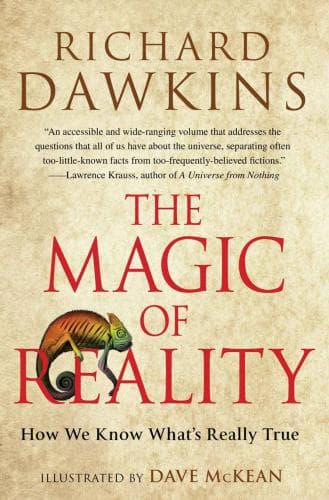
The Magic of Reality: How We Know What's Really True
سحر الواقع: كيف نعرف ما هو صحيح حقاً
La Magie de la Réalité : Comment Nous Savons Ce Qui Est Vraiment Vrai
Editorial summary
This work presents a systematic examination of scientific explanations for natural phenomena traditionally attributed to supernatural causes. Dawkins structures his analysis around twelve fundamental questions about the world, ranging from cosmological origins to biological diversity, demonstrating how scientific inquiry provides more satisfying and verifiable answers than mythological or religious narratives. The text explicitly targets younger readers while maintaining substantive engagement with epistemological questions about knowledge acquisition and the nature of reality.
The author employs a distinctive comparative methodology, juxtaposing creation myths and supernatural explanations from various cultures with corresponding scientific accounts. This approach serves dual purposes: acknowledging the historical ubiquity of religious explanations while demonstrating their explanatory inadequacy compared to empirical investigation. Dawkins argues that scientific understanding, far from diminishing wonder, actually enhances appreciation of natural phenomena by revealing their true complexity and elegance.
Central to the work's argument is an implicit critique of religious epistemology. While not directly engaging theological arguments in the manner of his previous works, Dawkins systematically undermines the credibility of supernatural explanations by demonstrating their failure to predict, explain, or coherently account for observable phenomena. The text advocates for methodological naturalism as the only reliable path to genuine knowledge, presenting evolution, atomic theory, and cosmology as exemplars of successful scientific explanation.
The contribution to contemporary debates about God lies primarily in its pedagogical approach to scientific literacy as prophylaxis against religious thinking. Dawkins positions scientific education as crucial for developing critical thinking skills that naturally lead to rejection of supernatural claims. This represents a strategic shift from direct theological argumentation to addressing the cultural and educational conditions that perpetuate religious belief.
The work situates itself within the broader New Atheist project of promoting scientific rationalism as a comprehensive worldview. However, its focus on wonder and beauty in nature distinguishes it from purely polemical treatments. Dawkins argues that reality possesses a "magic" that surpasses fiction precisely because it is true and discoverable through human reason. This rhetorical strategy attempts to reclaim the emotional and aesthetic territory often ceded to religious discourse while maintaining strict naturalistic commitments. The text thus contributes to secularization discourse by offering science not merely as an alternative to religious explanation but as a superior source of both truth and meaning.
Argument formulations engaged
Related works
Dawkins, Richard (2011). The Magic of Reality: How We Know What's Really True. Bantam Press.
@book{the-magic-of-reality-how-we-know-whats-r,
  author    = {Dawkins, Richard},
  title     = {The Magic of Reality: How We Know What's Really True},
  year      = {2011},
  publisher = {Bantam Press},
  url       = {https://god-database.com/en/works/the-magic-of-reality-how-we-know-whats-really-true-2011}
}