
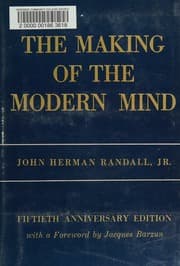
The Making of the Modern Mind
صنع العقل الحديث
La Formation de l'Esprit moderne
Editorial summary
This expansive intellectual history traces the development of Western thought from medieval synthesis through the scientific revolution to the modern worldview, examining how changing conceptions of nature, knowledge, and human purpose fundamentally altered humanity's relationship to the divine. Randall's analysis demonstrates how the transition from a God-centered medieval cosmos to a naturalistic modern universe represents not merely a shift in scientific understanding but a profound transformation in the metaphysical foundations of Western civilization.
The work charts how medieval thought integrated Aristotelian philosophy with Christian theology to create a unified vision where God functioned as both prime mover and ultimate telos. This synthesis provided coherent answers to questions of causation, purpose, and value within a hierarchical cosmos. Randall details how this framework began fragmenting during the Renaissance as humanistic concerns and empirical methods challenged scholastic authority. The scientific revolution accelerated this dissolution, replacing teleological explanations with mechanical causation and mathematical description.
Randall argues that modern science's success in explaining natural phenomena without reference to divine intervention created an unprecedented intellectual crisis. The mechanistic worldview pioneered by Galileo and Newton eliminated purpose from nature while Cartesian dualism severed the connection between material and spiritual realms. The Enlightenment attempted to reconstruct meaning through reason alone, producing deism's compromise between scientific naturalism and residual religious sensibility. However, Randall shows how even this attenuated theology proved unstable as scientific explanation expanded into domains previously reserved for religious interpretation.
The analysis extends through romanticism's reaction against mechanistic reductionism and the nineteenth century's evolutionary naturalism, demonstrating how each intellectual movement grappled with preserving human meaning and value in an increasingly godless cosmos. Randall examines how modern philosophy from Kant through pragmatism represents various strategies for addressing this crisis, whether through limiting reason's scope, embracing naturalistic humanism, or reconceiving religious experience in psychological terms.
While maintaining scholarly objectivity, Randall's narrative implicitly suggests that modernity's intellectual trajectory leads inexorably toward naturalistic explanations that render traditional theism obsolete. His comprehensive treatment illuminates how the "modern mind" emerged through cumulative challenges to religious worldviews, producing contemporary tensions between scientific understanding and spiritual aspiration that remain unresolved.
Argument formulations engaged
Jr., John Herman Randall (1940). The Making of the Modern Mind. Houghton Mifflin Company.
@book{the-making-of-the-modern-mind-1940,
  author    = {Jr., John Herman Randall},
  title     = {The Making of the Modern Mind},
  year      = {1940},
  publisher = {Houghton Mifflin Company},
  url       = {https://god-database.com/en/works/the-making-of-the-modern-mind-1940}
}