
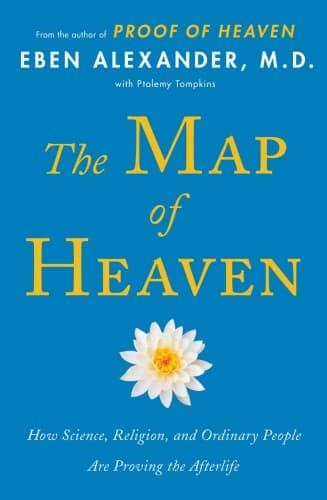
The Map of Heaven: How Science, Religion, and Ordinary People Are Proving the Afterlife
خريطة السماء: كيف يثبت العلم والدين والناس العاديون الحياة الآخرة
La Carte du Paradis : Comment la Science, la Religion et les Gens ordinaires prouvent l'Au-delà
Editorial summary
This work presents a physician's systematic investigation into near-death experiences and their implications for understanding consciousness and the afterlife. Alexander, a neurosurgeon who experienced a profound near-death experience during a coma caused by bacterial meningitis, constructs an argument for the reality of consciousness beyond physical death through the convergence of personal testimony, scientific inquiry, and cross-cultural spiritual traditions.
The author's central thesis challenges materialist neuroscience by proposing that consciousness exists independently of brain function. Alexander argues that his own experience, occurring when his neocortex was completely inactive, demonstrates that consciousness cannot be reduced to neural activity alone. He positions his work against prevailing scientific orthodoxy that treats consciousness as an epiphenomenon of brain states, drawing instead on quantum physics and emerging theories of consciousness to support a non-materialist framework.
Methodologically, Alexander combines autobiographical narrative with empirical analysis of near-death experience research. He examines thousands of documented cases, identifying consistent patterns across diverse cultural and religious backgrounds. The work engages with skeptical objections systematically, addressing alternative explanations such as hallucination, oxygen deprivation, and neurochemical processes. Alexander's medical credentials and prior skepticism serve rhetorically to establish credibility with scientifically-minded readers who might otherwise dismiss spiritual claims.
The text situates itself within ongoing debates between scientific materialism and religious worldviews, attempting to forge a middle path that honors empirical rigor while remaining open to transcendent dimensions of reality. Alexander draws on both contemporary consciousness researchers like Stuart Hameroff and traditional religious sources to construct what he terms a "map" of non-physical realms. This cartographic metaphor suggests that spiritual territories can be charted with the same precision as physical landscapes.
The work's significance lies in its challenge to disciplinary boundaries between neuroscience, philosophy of mind, and theology. By presenting near-death experiences as empirical data requiring scientific explanation, Alexander reframes the God question as amenable to evidential investigation rather than faith alone. His argument that consciousness survives bodily death directly supports theistic and spiritual worldviews while maintaining scientific vocabulary and methodology. This approach represents a notable attempt to reconcile scientific and religious epistemologies through phenomenological evidence, contributing to contemporary discussions about the nature of consciousness and its relationship to physical reality.
Argument formulations engaged
Related works
Alexander, Eben (2014). The Map of Heaven: How Science, Religion, and Ordinary People Are Proving the Afterlife.
@book{the-map-of-heaven-how-science-religion-a,
  author    = {Alexander, Eben},
  title     = {The Map of Heaven: How Science, Religion, and Ordinary People Are Proving the Afterlife},
  year      = {2014},
  url       = {https://god-database.com/en/works/the-map-of-heaven-how-science-religion-and-ordinary-people-are-proving-the-afterlife-2014}
}