
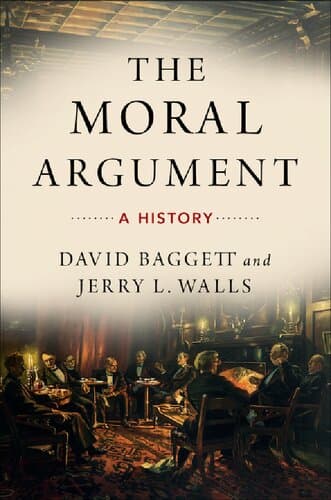
The Moral Argument: A History
الحجة الأخلاقية: تاريخ
L'Argument Moral : Une Histoire
Editorial summary
This monograph provides a comprehensive historical survey of the moral argument for God's existence, tracing its development from ancient philosophy through contemporary debates. Baggett examines how thinkers across centuries have argued that objective morality requires a divine foundation, while also documenting the evolution of counterarguments and refinements to this position.
The work begins with classical formulations, exploring how Plato's Form of the Good and Aristotelian virtue ethics laid groundwork for later theistic appropriations. Baggett demonstrates how early Christian thinkers, particularly Augustine and Aquinas, transformed these Greek insights into explicitly theological arguments linking moral law to divine command or divine nature. The analysis reveals how medieval scholastics developed sophisticated accounts of natural law theory that connected human moral knowledge to participation in eternal law.
Moving through the Enlightenment period, Baggett examines the crucial contributions of Kant, whose practical postulate of God's existence based on the highest good represents a watershed moment in moral argumentation. The text carefully analyzes how Kant's deontological ethics, while attempting to ground morality in reason alone, ultimately requires God to guarantee the alignment of virtue and happiness. Post-Kantian developments receive substantial attention, including British intuitionists, American pragmatists, and continental phenomenologists who variously affirmed or challenged the theistic implications of moral experience.
The contemporary landscape occupies significant space in Baggett's narrative. He explores twentieth-century reformulations by C.S. Lewis, whose popular presentations reached broad audiences, and more technical versions developed by philosophers like Robert Adams, Philip Quinn, and William Lane Craig. The work engages seriously with naturalistic alternatives, examining how thinkers from J.L. Mackie to Richard Joyce have argued for evolutionary or constructivist accounts of morality that dispense with divine foundations. Recent debates about moral ontology, epistemology, and motivation receive careful treatment, with attention to how contemporary moral realists and anti-realists position themselves regarding theistic implications.
Baggett's historical approach illuminates recurring patterns in moral argumentation while highlighting how cultural contexts shape specific formulations. The monograph serves as both a reference work for scholars and an introduction for those seeking to understand how the moral argument has functioned as a perennial strategy in natural theology, adapting to new philosophical challenges while maintaining its core insight that moral facts point beyond themselves to a transcendent source.
Argument formulations engaged
Baggett, David (2019). The Moral Argument: A History. Oxford University Press.
@book{the-moral-argument-a-history-2019,
  author    = {Baggett, David},
  title     = {The Moral Argument: A History},
  year      = {2019},
  publisher = {Oxford University Press},
  url       = {https://god-database.com/en/works/the-moral-argument-a-history-2019}
}