
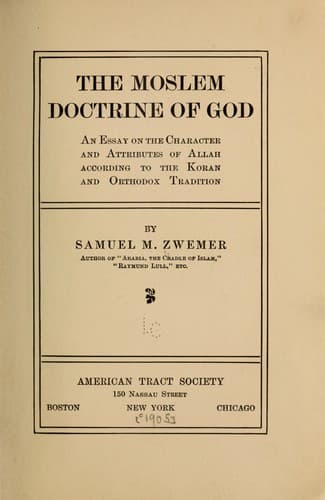
The Moslem doctrine of God.. An Essay on the Character and Attributes of Allah according to the Koran and Orthodox Tradition
العقيدة الإسلامية في الله.. مقالة في طبيعة الله وصفاته وفق القرآن والتقليد الأرثوذكسي
La Doctrine musulmane de Dieu.. Essai sur la nature et les attributs d'Allah selon le Coran et la tradition orthodoxe
The Islamic doctrine of God, as derived from the Qur'an and orthodox tradition, presents a conception of Allah whose character and attributes differ fundamentally from the Christian understanding of a personal, relational God.
Editorial summary
Samuel M. Zwemer's "The Moslem doctrine of God" represents an early twentieth-century Christian missionary's systematic examination of Islamic theology, specifically analyzing Quranic and traditional Islamic conceptions of Allah's nature and attributes. Writing from within the Christian apologetic tradition, Zwemer undertakes a comprehensive textual analysis that scrutinizes Islamic source materials while maintaining a critical comparative stance rooted in Reformed Protestant theology.
The work proceeds through methodical examination of Islamic texts, particularly the Quran and hadith literature, to delineate the Islamic understanding of divine attributes. Zwemer analyzes the ninety-nine names of Allah, examining how Islamic theology articulates divine transcendence, unity (tawhid), and sovereignty. His treatment addresses classical Islamic theological debates about divine attributes, including discussions between Ash'arite and Mu'tazilite schools regarding the relationship between Allah's essence and attributes. The author pays particular attention to how Islamic monotheism differs from Christian Trinitarian doctrine, arguing that the Islamic conception lacks certain relational qualities he considers essential to genuine theism.
Central to Zwemer's critique is his engagement with prophecy arguments, particularly concerning Muhammad's prophetic claims and their theological implications. He examines how Islamic doctrine grounds its understanding of God in prophetic revelation, contrasting this with what he presents as superior Christian epistemological foundations. The work challenges Islamic claims about Biblical corruption (tahrif) and argues that the Quranic portrayal of Allah reflects pre-Islamic Arabian religious concepts rather than authentic Abrahamic monotheism.
Zwemer's contribution to the God debate lies in its detailed documentation of Islamic theological sources for Western Christian audiences, albeit through a polemical lens. His work exemplifies early orientalist scholarship that, while demonstrating considerable textual knowledge, approaches Islamic theology primarily as an object of refutation rather than sympathetic understanding. The monograph's significance extends beyond its immediate missionary context, as it preserves detailed engagement with Islamic sources and theological arguments that would influence subsequent Christian-Muslim theological dialogue.
Despite its apologetic agenda, the work provides substantive analysis of how Islamic tradition conceptualizes divine nature, offering insights into fundamental theological differences between Islamic and Christian theism. Zwemer's examination of divine attributes, prophetic authority, and revelatory epistemology contributes to broader discussions about how monotheistic traditions construct and defend their understanding of God's nature and relationship to creation.
Structured analysis
Argument formulations engaged
Zwemer, Samuel M. (1906). The Moslem doctrine of God.. An Essay on the Character and Attributes of Allah according to the Koran and Orthodox Tradition. Gorgias Press.
@book{the-moslem-doctrine-of-god-an-essay-on-t,
  author    = {Zwemer, Samuel M.},
  title     = {The Moslem doctrine of God.. An Essay on the Character and Attributes of Allah according to the Koran and Orthodox Tradition},
  year      = {1906},
  publisher = {Gorgias Press},
  url       = {https://god-database.com/en/works/the-moslem-doctrine-of-god-an-essay-on-the-character-and-attributes-of-allah-according-to-the-koran-and-orthodox-traditi}
}