
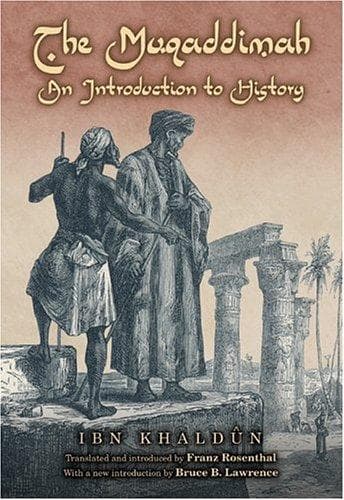
The Muqaddimah: An Introduction to History
المقدمة: مقدمة في التاريخ
La Muqaddima : Une Introduction à l'Histoire
Editorial summary
Ibn Khaldun's monumental work represents a pioneering attempt to establish a scientific methodology for understanding human civilization and historical development. Written in 1377, the Muqaddimah serves as the prolegomenon to his universal history, introducing revolutionary concepts that would later influence both Islamic and Western thought on society, economics, and the philosophy of history.
Central to Ibn Khaldun's approach is his synthesis of religious understanding with empirical observation. He argues that while divine providence ultimately governs human affairs, God operates through observable natural laws and social patterns that can be studied systematically. This methodological innovation positions him uniquely in medieval Islamic thought, as he neither reduces history to purely theological determinism nor abandons religious frameworks entirely. Instead, he develops what might be termed a "theistic naturalism" where divine wisdom manifests through predictable social mechanisms.
Ibn Khaldun critiques both the uncritical acceptance of historical narratives and the tendency of earlier Muslim historians to attribute all causation directly to divine intervention without examining intermediate causes. He argues that God has established laws governing the rise and fall of civilizations, the transition from nomadic to sedentary life, and the dynamics of political power. These laws operate consistently and can be discovered through careful observation and rational analysis, though they ultimately reflect divine wisdom and purpose.
His treatment of prophecy and religion demonstrates this synthetic approach. While affirming the reality of prophetic revelation and its crucial role in establishing civilization, Ibn Khaldun simultaneously analyzes religion as a social force subject to historical patterns. He examines how religious solidarity strengthens group cohesion, how prophetic movements arise in specific social conditions, and how religious institutions evolve within the lifecycle of dynasties.
The work's significance for discussions about God lies in its sophisticated integration of religious and naturalistic explanations. Ibn Khaldun provides a model for understanding divine action in history that respects both theological commitments and empirical investigation. His influence extends beyond Islamic thought, as Enlightenment thinkers would later grapple with similar questions about providence and natural law. The Muqaddimah thus represents a crucial contribution to debates about how God's sovereignty relates to human agency and natural causation, offering a nuanced position that avoids both secular reductionism and simplistic providentialism.
Argument formulations engaged
Ibn Khaldun (1377). The Muqaddimah: An Introduction to History.
@book{the-muqaddimah-an-introduction-to-histor,
  author    = {Ibn Khaldun},
  title     = {The Muqaddimah: An Introduction to History},
  year      = {1377},
  url       = {https://god-database.com/en/works/the-muqaddimah-an-introduction-to-history-1377}
}