
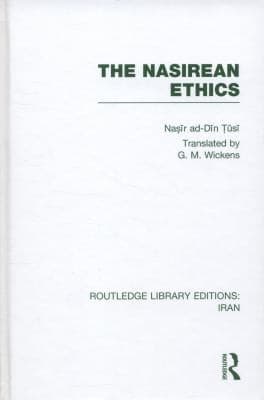
The Nasirean Ethics
الأخلاق النصيرية
L'Éthique nasirienne
Editorial summary
Nasir al-Din al-Tusi's The Nasirean Ethics represents a significant contribution to Islamic philosophical discourse on divine order and human perfection, synthesizing Aristotelian ethics with Islamic theology and Persian wisdom traditions. Writing in the tumultuous period of Mongol invasions, al-Tusi constructs a comprehensive ethical system that grounds moral philosophy in metaphysical realities, particularly the nature of God and the human soul's relationship to the divine.
The work advances a hierarchical cosmology where God functions as the Necessary Existent from whom all being emanates. Al-Tusi argues that human ethics must align with this divine order, presenting virtue not merely as social convention but as participation in cosmic harmony. His analysis draws heavily on Ibn Miskawayh's Tahdhib al-Akhlaq while incorporating Avicennian metaphysics, creating a sophisticated framework where practical ethics emerges from theoretical knowledge of God's nature. The text systematically demonstrates how understanding divine attributes provides the foundation for human character development, with justice serving as the cardinal virtue that mirrors divine order in human society.
Al-Tusi's method combines philosophical argumentation with religious sources, employing both rational demonstration and scriptural evidence. He engages critically with pure philosophical ethics that neglect revelation, while equally challenging religious approaches that dismiss reason. His treatment of the soul's faculties shows particular originality, explaining how each human capacity finds its perfection through orientation toward the divine. The work addresses skeptics who question whether ethics requires theological grounding, offering detailed refutations that link moral relativism to metaphysical error.
The treatise's significance extends beyond ethical theory to fundamental questions about God's relationship to creation. Al-Tusi presents divine providence not as arbitrary will but as rational order accessible to human understanding. His discussion of happiness as the soul's approximation to divine perfection provides a theistic response to naturalistic ethics, while his integration of Shi'i theological principles offers a distinctive perspective within Islamic philosophy. The work profoundly influenced subsequent Islamic thought, particularly in its synthesis of Greek philosophy with Quranic theology, establishing a model for how revealed religion and rational inquiry jointly illuminate the divine foundation of human moral life.
Argument formulations engaged
al-Tusi, Nasir al-Din (1235). The Nasirean Ethics. BRILL.
@book{the-nasirean-ethics-1235,
  author    = {al-Tusi, Nasir al-Din},
  title     = {The Nasirean Ethics},
  year      = {1235},
  publisher = {BRILL},
  url       = {https://god-database.com/en/works/the-nasirean-ethics-1235}
}