
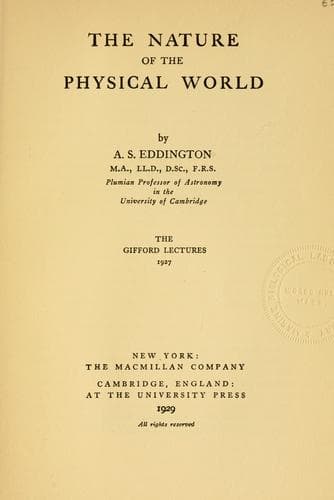
The Nature of the Physical World
طبيعة العالم الفيزيائي
La Nature du Monde physique
Editorial summary
Eddington's The Nature of the Physical World presents a distinctive philosophical interpretation of twentieth-century physics that challenges materialist worldviews and opens conceptual space for religious belief. Writing as both a leading astrophysicist and a Quaker, Eddington develops an idealist philosophy of science that emphasizes the constructed, symbolic nature of physical theories while arguing for the reality of consciousness and spiritual experience.
The work emerges from Eddington's Gifford Lectures and reflects the revolutionary developments in physics during the 1920s, particularly quantum mechanics and relativity theory. Against the mechanistic materialism that dominated nineteenth-century science, Eddington argues that modern physics reveals the abstract, mathematical character of scientific knowledge. He famously distinguishes between two tables: the familiar table of everyday experience and the scientific table composed mostly of empty space with scattered electric charges. This distinction serves to illustrate his central thesis that physics deals not with concrete material substances but with pointer readings and mathematical relations.
Eddington develops a selective subjectivist epistemology that locates the meaningful content of physics in the structure of relationships rather than in any supposed material substrate. He argues that the mind actively constructs scientific knowledge by imposing patterns on experience, suggesting that consciousness plays a fundamental role in our understanding of reality. This philosophical framework allows him to argue that science, properly understood, poses no threat to religious belief. Indeed, he contends that the abstract nature of physical reality revealed by modern science makes materialism untenable and creates legitimate space for spiritual realities beyond the scope of physics.
The work's significance for discussions of God lies in its sophisticated attempt to reconcile scientific and religious worldviews through philosophical analysis of physics itself. Eddington rejects both naive realism and pure phenomenalism, developing instead a nuanced position that acknowledges the genuine achievements of science while denying that physics exhausts reality. His argument that consciousness cannot be reduced to physical processes and his defense of human free will against determinism provide philosophical support for theistic beliefs. The work influenced subsequent discussions about the implications of quantum mechanics for theology and helped establish a tradition of scientist-philosophers who argue that modern physics is more compatible with idealism or theism than with materialism.
Argument formulations engaged
Eddington, Arthur (1928). The Nature of the Physical World. Shizu Bito.
@book{the-nature-of-the-physical-world-1928,
  author    = {Eddington, Arthur},
  title     = {The Nature of the Physical World},
  year      = {1928},
  publisher = {Shizu Bito},
  url       = {https://god-database.com/en/works/the-nature-of-the-physical-world-1928}
}