
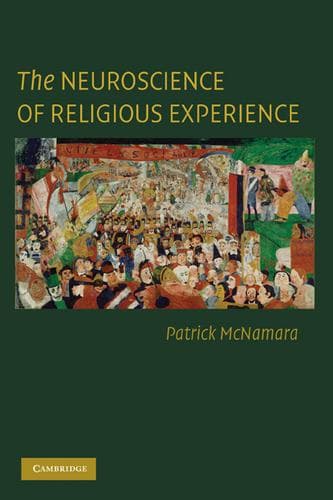
The Neuroscience of Religious Experience
علم الأعصاب للتجربة الدينية
Les Neurosciences de l'expérience religieuse
Editorial summary
This monograph examines religious experience through the lens of contemporary neuroscience, offering a naturalistic account of how the human brain generates and sustains religious phenomena. McNamara synthesizes findings from neuroimaging studies, clinical observations of patients with neurological disorders, and evolutionary psychology to construct a comprehensive theory of religion's neural substrates. The work positions itself within the growing field of neurotheology while maintaining critical distance from both reductionist materialism and supernatural explanations.
The central argument advances a "decentering" hypothesis, proposing that religious experiences arise from specific patterns of brain activation that temporarily suspend or alter the normal sense of self. McNamara identifies key neural networks, particularly those involving the frontal and temporal lobes, that become activated during prayer, meditation, and mystical experiences. Through detailed analysis of brain imaging data, the text demonstrates how religious practices can produce measurable changes in neural activity, particularly in regions associated with self-awareness, emotional regulation, and social cognition.
McNamara engages critically with earlier neuroscientific approaches to religion, particularly those that sought to locate a single "God spot" in the brain. Instead, the work argues for a distributed neural network model that accounts for the complexity and diversity of religious experiences across cultures. The analysis extends beyond individual psychology to consider religion's evolutionary functions, suggesting that religious capacities emerged through natural selection due to their adaptive benefits for group cohesion and individual well-being.
The methodological approach combines empirical neuroscience with phenomenological analysis, drawing on first-person accounts of religious experience to inform the interpretation of neural data. This interdisciplinary framework allows McNamara to address both the biological mechanisms and experiential dimensions of religious phenomena. The work explicitly challenges both religious fundamentalism and militant atheism, proposing instead that neuroscience reveals religion as a natural human capacity that serves important psychological and social functions.
The monograph's significance lies in its balanced treatment of a contentious topic, avoiding both the reductionism that dismisses religious experience as mere neural misfiring and the dualism that places religion beyond scientific investigation. McNamara demonstrates how neuroscientific research can illuminate the nature of religious experience without necessarily determining its ultimate truth or falsity, thus contributing a sophisticated naturalistic perspective to contemporary debates about God and human religiosity.
Argument formulations engaged
McNamara, Patrick (2009). The Neuroscience of Religious Experience. Cambridge University Press.
@book{the-neuroscience-of-religious-experience,
  author    = {McNamara, Patrick},
  title     = {The Neuroscience of Religious Experience},
  year      = {2009},
  publisher = {Cambridge University Press},
  url       = {https://god-database.com/en/works/the-neuroscience-of-religious-experience-2009}
}