
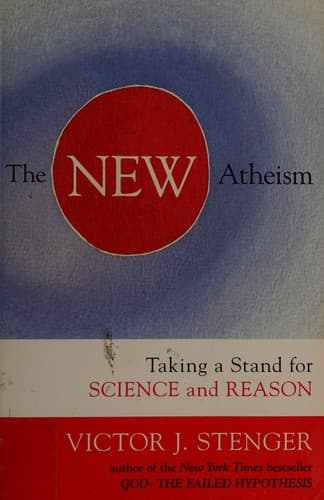
The New Atheism
الإلحاد الجديد
Le Nouvel Athéisme
Editorial summary
Victor Stenger's The New Atheism situates itself as both a defense and philosophical extension of the movement that emerged in the early 21st century through works by Richard Dawkins, Christopher Hitchens, Sam Harris, and Daniel Dennett. Stenger, a particle physicist turned philosopher, brings his scientific background to bear on traditional arguments for God's existence while advancing a distinctly naturalistic worldview that seeks to demonstrate the incompatibility of scientific knowledge with theistic belief.
The monograph distinguishes itself from other New Atheist texts through its systematic engagement with contemporary physics and cosmology. Where Dawkins focuses primarily on evolutionary biology and Hitchens on moral and political critiques, Stenger examines how modern physics allegedly undermines classical theistic arguments, particularly those concerning cosmic fine-tuning and the origin of the universe. He contends that quantum mechanics and cosmological theories provide sufficient explanatory power without recourse to supernatural causation, directly challenging philosophers like William Lane Craig and scientists like Francis Collins who argue for theistic interpretations of physical laws.
Stenger's methodology combines empirical analysis with philosophical argumentation, though critics note his tendency to conflate methodological naturalism with metaphysical naturalism. He argues that the absence of empirical evidence for divine action, combined with the explanatory success of purely natural processes, justifies positive atheism rather than mere agnosticism. This position sets him apart from more cautious scientific critics of religion who maintain epistemic humility about ultimate metaphysical questions.
The work's significance lies in its attempt to provide scientific grounding for strong atheism, moving beyond the sociological and historical critiques common in New Atheist literature. Stenger engages directly with sophisticated natural theology, particularly arguments from cosmological constants and the anthropic principle, offering detailed rebuttals based on multiverse theories and statistical analysis. His treatment of the relationship between quantum indeterminacy and free will also addresses theological concerns about divine action and human agency.
While The New Atheism reinforces familiar criticisms of religious belief, its contribution centers on demonstrating how contemporary physics can support comprehensive philosophical naturalism. Stenger's work represents an important voice in early 21st century debates about science and religion, particularly in its assertion that scientific knowledge not only fails to support theism but actively contradicts it.
Argument formulations engaged
Stenger, Victor (2009). The New Atheism.
@book{the-new-atheism-2009,
  author    = {Stenger, Victor},
  title     = {The New Atheism},
  year      = {2009},
  url       = {https://god-database.com/en/works/the-new-atheism-2009}
}