
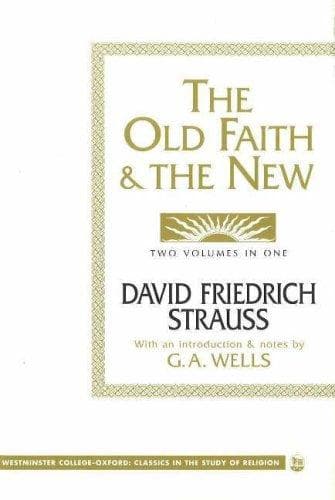
The Old Faith and the New
الإيمان القديم والجديد
L'Ancienne Foi et la Nouvelle
Editorial summary
David Friedrich Strauss's The Old Faith and the New represents a decisive intervention in nineteenth-century debates about religion and modernity, articulating a thoroughgoing naturalistic worldview that explicitly rejects traditional theism in favor of scientific materialism. Writing in the aftermath of Darwin's revolutionary work and the rise of biblical criticism, Strauss addresses what he considers the fundamental question of his age: whether educated individuals can remain Christians in light of modern knowledge.
The work systematically dismantles the foundations of Christian belief through four interconnected questions: Are we still Christians? Have we still a religion? What is our conception of the universe? What is our rule of life? Strauss answers the first negatively, arguing that historical criticism has irreparably undermined the credibility of Christian scripture and doctrine. To the second, he responds affirmatively but redefines religion as reverence for the cosmos understood through natural science rather than supernatural revelation. His conception of the universe draws heavily on contemporary physics and evolutionary biology, presenting nature as a self-sufficient system requiring no divine intervention or purpose.
Strauss's method combines philosophical argumentation with appeals to scientific authority, particularly invoking Darwin, Kant, and contemporary German physicists. He positions himself against both orthodox Christianity and the compromising liberal theology of figures like Schleiermacher, whom he criticizes for attempting to preserve religious sentiment while abandoning religious substance. The work exemplifies the confidence of nineteenth-century scientific materialism, treating religious belief as a historical stage humanity must transcend through intellectual progress.
The monograph's significance lies in its uncompromising articulation of naturalistic atheism as a complete worldview capable of addressing ethical and existential questions traditionally reserved for religion. Strauss argues that morality derives from human nature and social evolution rather than divine command, and that aesthetic appreciation of the cosmos can fulfill emotional needs previously met by religious worship. His frank dismissal of personal immortality and divine providence exemplifies the radical implications of consistently applied naturalism.
The Old Faith and the New matters to the God debate as an influential example of post-Hegelian materialism that helped establish atheism as a respectable intellectual position in European thought. Its reception sparked fierce controversy, with critics attacking both its philosophical arguments and its cultural implications, while supporters praised its intellectual honesty and systematic coherence in developing a purely naturalistic philosophy of life.
Argument formulations engaged
Related works
Strauss, David Friedrich (1872). The Old Faith and the New.
@book{the-old-faith-and-the-new-1872,
  author    = {Strauss, David Friedrich},
  title     = {The Old Faith and the New},
  year      = {1872},
  url       = {https://god-database.com/en/works/the-old-faith-and-the-new-1872}
}