
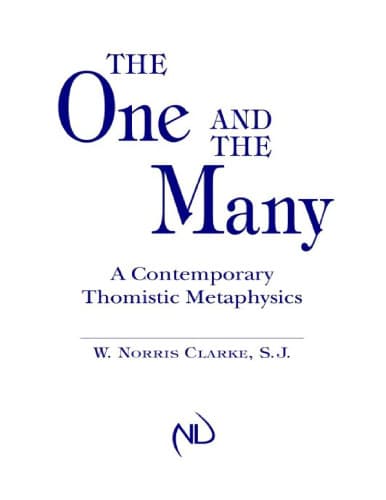
The One and the Many: A Contemporary Thomistic Metaphysics
الواحد والمتعدد: ميتافيزيقا توماوية معاصرة
L'Un et le Multiple : Une métaphysique thomiste contemporaine
Editorial summary
This monograph presents a systematic reconstruction of Thomistic metaphysics designed to engage contemporary philosophical discourse while remaining faithful to Thomas Aquinas's core insights. Clarke develops a comprehensive metaphysical framework centered on the dynamic interplay between existence and essence, arguing that this provides crucial resources for understanding God's relationship to creation in ways that address modern philosophical concerns.
The work's central contribution to the God debate lies in its articulation of participation metaphysics as a middle path between pantheism and deism. Clarke argues that finite beings participate in divine existence without being identical to God, establishing a relationship of real dependence that preserves both divine transcendence and immanence. This framework directly challenges process theology's limitations on divine perfection and answers naturalistic critiques that portray classical theism as philosophically obsolete.
Clarke's method combines historical retrieval with creative development, drawing extensively on Aquinas while incorporating insights from personalist philosophy and phenomenology. He particularly emphasizes the relational dimension of being, arguing that substance and relation are equally primordial rather than treating relation as merely accidental. This move addresses modern concerns about static substance metaphysics while maintaining the classical theistic commitment to divine simplicity and immutability.
The monograph engages critically with several contemporary positions. Against analytical philosophers who reject metaphysics as meaningless, Clarke demonstrates how Thomistic principles can be reformulated in precise contemporary terms. He critiques both reductive materialism for its inability to account for consciousness and intentionality, and radical postmodern relativism for undermining the very possibility of truth claims about ultimate reality.
Significantly, Clarke develops an extended argument for God's existence based on the real distinction between essence and existence in finite beings. He contends that contingent beings cannot account for their own existence, requiring a necessary being whose essence is identical with existence. This reformulation of Aquinas's argument addresses Kantian objections while engaging contemporary debates about modal logic and necessary existence.
The work's importance extends beyond technical metaphysics to broader theological questions. Clarke's account of divine action in the world, human personhood as image of God, and the metaphysical foundations of ethics provides resources for addressing perennial tensions between divine sovereignty and human freedom. His synthesis demonstrates that classical theism, properly understood, remains philosophically viable and intellectually compelling in contemporary discourse.
Argument formulations engaged
Clarke, W. Norris (2001). The One and the Many: A Contemporary Thomistic Metaphysics.
@book{the-one-and-the-many-a-contemporary-thom,
  author    = {Clarke, W. Norris},
  title     = {The One and the Many: A Contemporary Thomistic Metaphysics},
  year      = {2001},
  url       = {https://god-database.com/en/works/the-one-and-the-many-a-contemporary-thomistic-metaphysics-2001}
}