
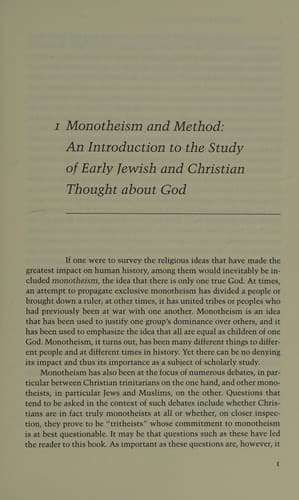
The Only True God: Early Christian Monotheism in Its Jewish Context
الإله الحقيقي الوحيد: التوحيد المسيحي المبكر في سياقه اليهودي
Le Seul Vrai Dieu : Le monothéisme chrétien primitif dans son contexte juif
Editorial summary
McGrath's monograph examines the development of early Christian monotheism through careful analysis of its Jewish theological matrix. The work challenges simplistic narratives about Christian innovation by demonstrating how emergent Christological claims remained fundamentally grounded in Jewish monotheistic frameworks, even as they stretched and redefined those boundaries.
The author employs a methodology that combines historical-critical analysis of early Christian texts with comparative study of Second Temple Jewish literature. McGrath particularly focuses on how early Christians navigated the tension between maintaining Jewish monotheistic commitments while simultaneously attributing divine status to Jesus. His approach differs markedly from scholars who posit a sharp discontinuity between Jewish and Christian conceptions of God, instead revealing complex processes of reinterpretation and theological creativity within established monotheistic parameters.
Central to McGrath's argument is his analysis of intermediary figures in Jewish thought—angels, personified divine attributes like Wisdom, and exalted patriarchs—which provided conceptual precedents for early Christian claims about Jesus. He demonstrates that the attribution of divine characteristics to Jesus followed patterns already present in Jewish speculation about such figures, though Christians ultimately pushed these concepts beyond their original boundaries. The work carefully traces how titles, functions, and worship practices associated with God in Jewish tradition came to be applied to Jesus while Christians continued to affirm fundamental monotheistic principles.
McGrath engages critically with scholars like Larry Hurtado and Richard Bauckham, who emphasize the radical nature of early Christian devotion to Jesus. While acknowledging the innovative aspects of Christian practice, McGrath argues for greater continuity with Jewish thought than these scholars allow. His analysis of texts from Paul through the Fourth Gospel reveals a gradual process of theological development rather than a sudden rupture with Jewish monotheism.
The monograph's significance lies in its nuanced treatment of a central question in understanding Christianity's emergence: how a movement within Judaism developed beliefs about Jesus that appeared to compromise strict monotheism while insisting on its preservation. McGrath's work contributes to broader discussions about religious innovation, the relationship between Judaism and Christianity, and the nature of monotheistic belief itself. By illuminating the Jewish roots of Christian theological development, the study offers important insights for contemporary interfaith dialogue and challenges oversimplified accounts of religious origins that ignore complex processes of tradition and transformation.
Argument formulations engaged
McGrath, James (2009). The Only True God: Early Christian Monotheism in Its Jewish Context.
@book{the-only-true-god-early-christian-monoth,
  author    = {McGrath, James},
  title     = {The Only True God: Early Christian Monotheism in Its Jewish Context},
  year      = {2009},
  url       = {https://god-database.com/en/works/the-only-true-god-early-christian-monotheism-in-its-jewish-context-2009}
}