
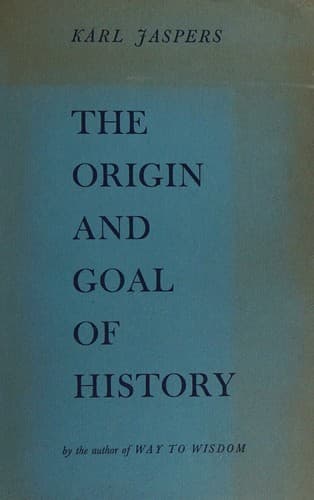
The Origin and Goal of History
أصل وهدف التاريخ
Origine et Sens de l'Histoire
Editorial summary
Karl Jaspers' The Origin and Goal of History presents a sweeping philosophical interpretation of human history that posits the emergence of a unified world consciousness rooted in what he terms the "Axial Age." This pivotal period, occurring roughly between 800 and 200 BCE, witnessed the simultaneous appearance of transformative spiritual and philosophical movements across disparate civilizations: the Hebrew prophets in Palestine, Zoroastrianism in Persia, Buddhism and Hinduism in India, Confucianism and Taoism in China, and Greek philosophy in the West. For Jaspers, this convergence represents more than historical coincidence; it signals a fundamental breakthrough in human consciousness toward transcendence.
Central to Jaspers' argument is the notion that the Axial Age inaugurated a universal framework for understanding the divine and ultimate reality. During this period, humanity first developed the capacity to conceive of transcendent absolutes, whether understood as the Hebrew God, the Buddhist Nirvana, the Chinese Tao, or the Greek logos. These diverse conceptions, while culturally specific, share a common orientation toward the unconditional and infinite. Jaspers argues that this shared breakthrough creates the possibility for genuine inter-religious and intercultural dialogue, as all post-Axial traditions participate in the same fundamental questioning about ultimate reality.
The work engages critically with both Christian exclusivism and secular historicism. Against Karl Löwith and other Christian philosophers of history, Jaspers rejects the notion that revelation to a particular people provides the key to universal history. He argues instead that the empirically observable Axial transformation offers a more inclusive foundation for understanding human spiritual development. Simultaneously, he challenges purely materialist interpretations of history by insisting on the irreducible significance of humanity's orientation toward transcendence.
Jaspers employs his existentialist philosophical method to interpret historical data, seeking to uncover the existential meaning of civilizational transformations. His approach combines historical analysis with philosophical reflection on the human condition, particularly the universal human experience of limit-situations that open awareness to transcendence. The work's significance lies in its attempt to provide a philosophical framework for understanding religious diversity while maintaining the validity of transcendent experience. By locating the origin of authentic spirituality in a shared historical moment rather than exclusive revelation, Jaspers offers a foundation for inter-religious understanding that neither reduces all traditions to the same content nor denies their genuine orientation toward ultimate reality.
Argument formulations engaged
Jaspers, Karl (1953). The Origin and Goal of History. Greenwood Press Reprint.
@book{the-origin-and-goal-of-history-1953,
  author    = {Jaspers, Karl},
  title     = {The Origin and Goal of History},
  year      = {1953},
  publisher = {Greenwood Press Reprint},
  url       = {https://god-database.com/en/works/the-origin-and-goal-of-history-1953}
}