
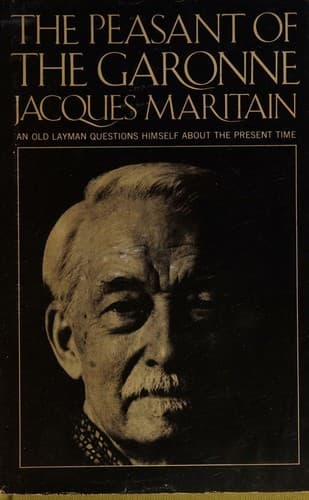
The Peasant of the Garonne
فلاح غارون
Le Paysan de la Garonne
Editorial summary
Maritain's final major work, The Peasant of the Garonne, presents a passionate defense of Thomistic theism against what he perceives as the theological confusion following the Second Vatican Council. Writing as a self-described "peasant" who speaks plainly about fundamental truths, Maritain critiques both progressive Catholics who he believes have abandoned essential doctrines and conservative Catholics who resist legitimate development. The work articulates a robust philosophical theism grounded in the perennial philosophy of Thomas Aquinas while engaging contemporary challenges to traditional belief.
The book's central theological contribution lies in its insistence that authentic Catholic renewal must preserve rather than abandon the rational foundations of theistic belief. Maritain argues forcefully against theologians who, in their enthusiasm for dialogue with modern thought, compromise the metaphysical realism that undergirds knowledge of God's existence and nature. He particularly criticizes phenomenological and existentialist approaches that he views as undermining the objective truth claims essential to theism. Against these trends, Maritain reasserts the continuing validity of Thomistic demonstrations of God's existence and the analogical knowledge of divine attributes.
Maritain's analysis extends to the relationship between nature and grace, defending the traditional distinction while emphasizing their intimate connection in concrete human existence. He argues that contemporary theology's tendency to blur this distinction ultimately weakens both natural knowledge of God and supernatural faith. The work develops a nuanced account of how philosophical reason prepares for and supports religious belief without determining its specific content. This position allows Maritain to maintain both the autonomy of philosophy in establishing God's existence and the necessity of revelation for full knowledge of the divine.
The text engages critically with various forms of modern atheism, particularly Marxist materialism and existentialist nihilism, while also addressing the "practical atheism" he detects among some believers who nominally accept God's existence but live as if God were irrelevant. Maritain's method combines rigorous philosophical argumentation with spiritual insight, drawing on his extensive engagement with contemporary art, politics, and culture to illustrate the practical implications of theistic belief.
The Peasant of the Garonne stands as a significant intervention in post-conciliar Catholic thought, defending traditional theistic metaphysics while acknowledging the legitimate concerns of modern consciousness. Its influence extends beyond Catholic philosophy to broader discussions about the rational credibility of theism in an increasingly secular age.
Argument formulations engaged
Related works
Maritain, Jacques (1966). The Peasant of the Garonne. Philosophy Documentation Center.
@book{the-peasant-of-the-garonne-1966,
  author    = {Maritain, Jacques},
  title     = {The Peasant of the Garonne},
  year      = {1966},
  publisher = {Philosophy Documentation Center},
  url       = {https://god-database.com/en/works/the-peasant-of-the-garonne-1966}
}