
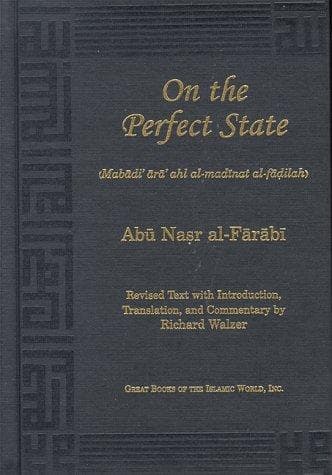
Editorial summary
The Perfect State presents al-Farabi's systematic philosophical account of political order grounded in metaphysical principles, offering a distinctive synthesis of Platonic political philosophy and Islamic monotheism. Writing in the tenth century, al-Farabi constructs his ideal state upon a comprehensive theory of divine emanation, where political authority derives its legitimacy from the ruler's intellectual connection to the Active Intellect and ultimately to God as the First Cause.
The work advances a hierarchical cosmology where God, as pure intellect and necessary existence, emanates ten successive intellects that govern the celestial spheres and culminate in the Active Intellect, which illuminates human minds. This metaphysical framework provides the foundation for al-Farabi's political theory: just as the universe operates through ordered emanation from the divine, so too should human society mirror this cosmic hierarchy. The philosopher-ruler, through intellectual perfection and connection to the Active Intellect, serves as the mediator between divine wisdom and political governance.
Al-Farabi's contribution to debates about God centers on his rationalist demonstration that properly ordered human society requires acknowledgment of divine providence and metaphysical truth. Against those who would separate political philosophy from theology, he argues that the perfect state must be organized according to the same principles that govern cosmic order. The ruler's primary qualification lies not in hereditary right or popular consent, but in philosophical knowledge of God and the emanative hierarchy. This knowledge enables the ruler to craft laws that guide citizens toward their ultimate perfection—intellectual contemplation of divine truth.
The text engages critically with purely secular conceptions of political authority while also challenging literalist religious approaches that reject philosophical reasoning. Al-Farabi demonstrates how Greek philosophical methods, particularly those of Plato and Aristotle, can be harmonized with Islamic monotheism to produce a rational account of divinely ordered political life. His emanationist metaphysics provides a sophisticated alternative to both anthropomorphic conceptions of divine governance and mechanistic views that eliminate divine providence from political considerations.
The Perfect State's enduring significance lies in its systematic integration of metaphysics, epistemology, and political philosophy within a theistic framework. By grounding political authority in the ruler's intellectual apprehension of divine truth rather than in revelation alone, al-Farabi establishes a philosophical basis for theocratic governance that influenced both Islamic and Jewish medieval thought, particularly Maimonides and subsequent Islamic political philosophers.
Argument formulations engaged
Related works
al-Farabi (940). The Perfect State. Clarendon Press.
@book{the-perfect-state-940,
  author    = {al-Farabi},
  title     = {The Perfect State},
  year      = {940},
  publisher = {Clarendon Press},
  url       = {https://god-database.com/en/works/the-perfect-state-940}
}