
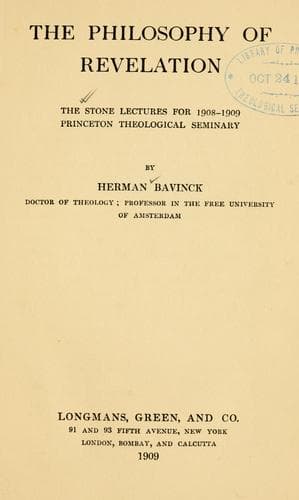
The Philosophy of Revelation
فلسفة الوحي
La Philosophie de la révélation
Editorial summary
Bavinck's The Philosophy of Revelation represents a systematic Reformed theological response to modern philosophy's treatment of divine disclosure, defending the coherence and necessity of supernatural revelation against naturalistic and idealistic alternatives. Writing in the early twentieth century context of growing secularization and philosophical challenges to traditional Christianity, Bavinck engages both continental philosophy and emerging modernist theology to articulate a comprehensive account of how God makes himself known to humanity.
The work proceeds through careful philosophical analysis of revelation as a category, examining its epistemological foundations and metaphysical implications. Bavinck critiques the Enlightenment reduction of revelation to natural reason, arguing that such approaches fail to account for the personal and historical character of divine self-disclosure. He engages extensively with German idealism, particularly Hegel's attempt to subsume revelation into philosophical speculation, contending that this dissolves the distinction between Creator and creation essential to authentic theism. Against Schleiermacher's subjectivization of revelation as religious feeling, Bavinck maintains that revelation possesses objective content communicated through historical acts and propositional truths.
Central to Bavinck's argument is the claim that general revelation in nature and conscience, while real and valuable, requires completion through special revelation in Scripture and Christ. He develops a nuanced account of how these two forms of revelation relate, avoiding both the rationalism that would make special revelation superfluous and the fideism that would disconnect faith from reason. The work demonstrates particular strength in showing how revelation addresses the whole person—intellect, will, and emotions—rather than merely conveying information.
Bavinck's contribution lies in his sophisticated integration of Reformed orthodoxy with contemporary philosophical discourse, demonstrating that traditional Christian claims about revelation can withstand and incorporate legitimate insights from modern thought. His treatment of revelation as both objective divine act and subjective human reception anticipates later twentieth-century discussions about the nature of religious knowledge. The work remains influential in Reformed circles and continues to offer resources for those defending the intelligibility of divine revelation against naturalistic reductionism. By grounding his philosophy of revelation in careful exegesis while engaging seriously with philosophical challenges, Bavinck provides a model for constructive theological engagement with modern thought that neither capitulates to secular premises nor retreats into anti-intellectual fundamentalism.
Argument formulations engaged
Bavinck, Herman (1909). The Philosophy of Revelation. Alev Books.
@book{the-philosophy-of-revelation-1909,
  author    = {Bavinck, Herman},
  title     = {The Philosophy of Revelation},
  year      = {1909},
  publisher = {Alev Books},
  url       = {https://god-database.com/en/works/the-philosophy-of-revelation-1909}
}