
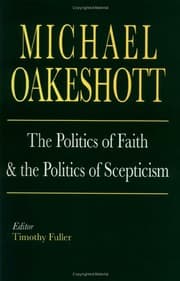
The Politics of Faith and The Politics of Scepticism
سياسة الإيمان وسياسة الشك
La politique de la foi et la politique du scepticisme
This volume, edited by Timothy Fuller and based on Michael Oakeshott's unpublished manuscript, argues that Western political thought oscillates between two fundamental dispositions — a politics of faith that pursues perfectibility through collective will, and a politics of scepticism that prizes limited government and inherited practice over ideological ambition.
Editorial summary
This monograph examines the enduring tension between faith and skepticism as fundamental orientations in political life, offering insights that bear significantly on debates about religion's role in public discourse. Fuller presents these opposing tendencies not as abstract philosophical positions but as practical political dispositions that shape how communities understand authority, order, and the possibilities of human achievement.
The work argues that politics perpetually oscillates between two poles: the politics of faith, which embraces confidence in human ability to achieve comprehensive solutions to social problems, and the politics of skepticism, which maintains doubt about grand political projects and emphasizes the limits of human knowledge and power. Fuller demonstrates that neither orientation can fully eliminate the other, as each contains internal contradictions that eventually strengthen its opposite. The politics of faith, when taken to extremes, generates disappointment and disillusionment that fuel skepticism. Conversely, thoroughgoing skepticism proves unstable, as human beings cannot indefinitely suspend belief in some organizing principles or shared purposes.
Drawing on the tradition of Michael Oakeshott, Fuller employs a method of philosophical analysis that examines the logical structure and practical implications of these political temperaments. He traces how modern political thought has struggled to balance these tendencies, showing that attempts to banish either faith or skepticism from politics inevitably fail. The work engages critically with Enlightenment confidence in reason and progress while also questioning conservative appeals to tradition and limitation.
Fuller's analysis contributes to the God debate by illuminating how theological questions intersect with political ones. The politics of faith often draws on religious sources or exhibits quasi-religious characteristics in its certainty and comprehensive vision. Meanwhile, political skepticism frequently allies with religious doubt or secular criticism of absolutist claims. However, Fuller demonstrates that these alignments remain unstable and reversible, as religious belief can support either political faith or political skepticism depending on theological emphasis.
The monograph's significance lies in its sophisticated treatment of how faith and doubt function politically rather than merely philosophically. By showing that neither orientation can achieve complete victory, Fuller suggests that political wisdom requires recognizing and moderating both tendencies rather than pursuing either to its logical conclusion. This insight proves valuable for understanding why debates about religion and politics resist final resolution.
Structured analysis
Argument formulations engaged
Fuller, Timothy (1996). The Politics of Faith and The Politics of Scepticism.
@book{the-politics-of-faith-and-the-politics-o,
  author    = {Fuller, Timothy},
  title     = {The Politics of Faith and The Politics of Scepticism},
  year      = {1996},
  url       = {https://god-database.com/en/works/the-politics-of-faith-and-the-politics-of-scepticism}
}