
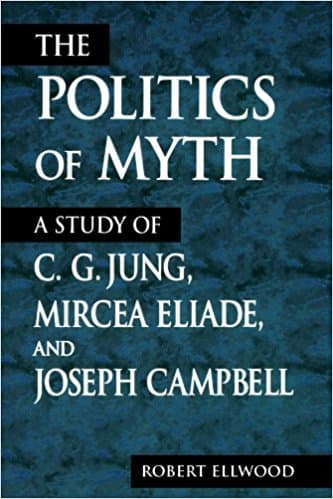
The Politics of Myth: A Study of C.G. Jung, Mircea Eliade, and Joseph Campbell
سياسة الأسطورة: دراسة في أعمال كارل غوستاف يونغ وميرسيا إلياده وجوزيف كامبل
La Politique du mythe : Une étude de C.G. Jung, Mircea Eliade et Joseph Campbell
Editorial summary
This comparative study examines how three influential twentieth-century scholars of myth—C.G. Jung, Mircea Eliade, and Joseph Campbell—constructed theories that carried implicit political and theological implications. Robert Ellwood investigates the intersection of myth theory with broader cultural and political currents, revealing how ostensibly neutral academic frameworks often encode particular worldviews about the divine, human nature, and social order.
Ellwood demonstrates that each thinker's approach to myth reflected distinctive assumptions about religious truth and its relationship to modernity. Jung's psychological interpretation of religious symbols as archetypal manifestations of the collective unconscious positioned the divine as an internal psychological reality rather than an external metaphysical one. This move effectively neutralized traditional theistic claims while preserving a space for religious experience within a scientifically credible framework. Eliade's phenomenological method, which sought to uncover the sacred as an irreducible category of human experience, challenged secular reductionism while avoiding explicit theological commitments. His emphasis on homo religiosus suggested that religious consciousness represents an essential human capacity, though he remained ambiguous about the ontological status of the sacred itself. Campbell's comparative mythology, popularized through his hero's journey monomyth, presented religious narratives as universal human stories that transcend particular theological claims, effectively relativizing specific religious traditions while affirming the psychological and social functions of myth.
The study reveals how these theoretical positions aligned with specific political orientations. Jung's individualistic psychology resonated with liberal democratic values, Eliade's anti-modern stance reflected conservative critiques of secularization, and Campbell's universalism supported a distinctly American spiritual pluralism. Ellwood argues that these scholars' treatments of myth cannot be divorced from their cultural contexts and political commitments, challenging the notion that the academic study of religion can remain purely descriptive or politically neutral.
By exposing the ideological dimensions of influential myth theories, Ellwood's work contributes to debates about the proper relationship between religious studies and theology. His analysis suggests that seemingly secular approaches to religious phenomena often smuggle in crypto-theological assumptions about the nature and value of religious experience. This critique has implications for how scholars approach the question of God, revealing that even methodologically agnostic positions may encode substantive claims about divine reality and its accessibility to human understanding.
Argument formulations engaged
Ellwood, Robert (1999). The Politics of Myth: A Study of C.G. Jung, Mircea Eliade, and Joseph Campbell. State University of New York Press.
@book{the-politics-of-myth-a-study-of-c-g-jung,
  author    = {Ellwood, Robert},
  title     = {The Politics of Myth: A Study of C.G. Jung, Mircea Eliade, and Joseph Campbell},
  year      = {1999},
  publisher = {State University of New York Press},
  url       = {https://god-database.com/en/works/the-politics-of-myth-a-study-of-c-g-jung-mircea-eliade-and-joseph-campbell-1999}
}