
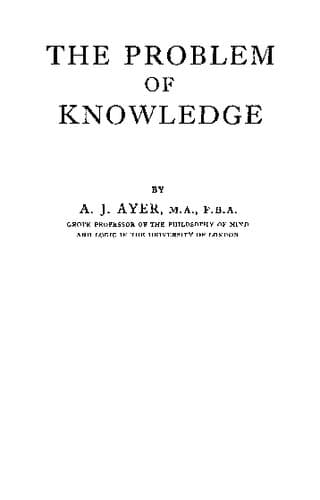
The Problem of Knowledge
مشكلة المعرفة
Le Problème de la connaissance
Editorial summary
This influential work in twentieth-century epistemology advances a rigorous empiricist framework that has significant implications for theological discourse, though Ayer does not make religious knowledge his central concern. Building on the logical positivist tradition he helped establish with Language, Truth and Logic (1936), Ayer develops a comprehensive theory of knowledge grounded in sense experience and logical analysis, systematically excluding metaphysical and theological claims from the domain of genuine knowledge.
Ayer constructs his epistemology around the verification principle, arguing that meaningful propositions must be either analytically true (tautologies) or empirically verifiable through sense experience. This framework relegates religious statements to the category of pseudo-propositions—neither true nor false but cognitively meaningless. While not explicitly targeting theological arguments throughout the work, Ayer's epistemological criteria effectively dissolve rather than refute religious claims, representing a more radical challenge than traditional atheistic arguments.
The monograph engages critically with rationalist epistemologies that might provide foundations for natural theology, particularly targeting the concept of synthetic a priori knowledge that theologians since Aquinas have employed. Ayer argues that all genuine knowledge derives from empirical observation or logical relations, leaving no epistemic space for revealed truth or rational intuitions about divine reality. His treatment of causation and necessity further undermines cosmological arguments by reducing causal claims to descriptions of observed regularities rather than metaphysical connections.
Significantly, Ayer addresses the problem of other minds in ways that indirectly challenge analogical arguments for divine consciousness. His behaviorist-leaning solution suggests that mental state attributions rest on observable criteria, implicitly questioning how one could meaningfully attribute consciousness or intentionality to an unobservable deity. The work's influence extends beyond professional philosophy, shaping mid-century intellectual culture's approach to religious questions by providing sophisticated tools for dismissing theological discourse as linguistically confused rather than merely false.
Ayer's epistemology represents a watershed in philosophy of religion, shifting debate from the truth of religious claims to their very intelligibility. By grounding knowledge exclusively in empirical verification and logical analysis, he articulates a worldview that renders traditional theological questions not wrong but meaningless—a position more threatening to religious thought than straightforward denial. His careful argumentation and systematic approach make this monograph essential reading for understanding how empiricist epistemology challenges the conceptual foundations of theistic belief.
Argument formulations engaged
Related works
Ayer, Alfred Jules (1956). The Problem of Knowledge. Penguin Books.
@book{the-problem-of-knowledge-1956,
  author    = {Ayer, Alfred Jules},
  title     = {The Problem of Knowledge},
  year      = {1956},
  publisher = {Penguin Books},
  url       = {https://god-database.com/en/works/the-problem-of-knowledge-1956}
}