
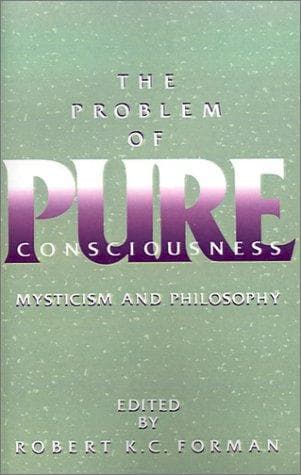
The Problem of Pure Consciousness
مشكلة الوعي الخالص
Le Problème de la conscience pure
Editorial summary
The Problem of Pure Consciousness presents a systematic challenge to the constructivist paradigm that dominated religious studies through the 1980s. Robert Forman assembles contributors who argue that mystical experiences, particularly states of pure consciousness devoid of conceptual content, cannot be reduced to linguistic, cultural, or doctrinal conditioning. This collection emerges as a direct response to Steven Katz's influential constructivist position that all experience is inherently mediated by preexisting conceptual frameworks.
The volume's central thesis maintains that certain mystical states transcend cultural determination and point toward universal features of human consciousness. Contributors examine evidence from diverse contemplative traditions including Hindu yoga, Buddhist meditation, Christian mysticism, and Jewish Kabbalah. They argue that reports of contentless awareness, where practitioners describe consciousness without subject-object duality or conceptual overlay, demonstrate remarkable cross-cultural consistency that constructivism cannot adequately explain.
Forman's introductory framework distinguishes between pure consciousness events and other mystical phenomena, establishing methodological criteria for identifying genuinely contentless states. The collected essays employ phenomenological analysis, comparative textual study, and philosophical argumentation to build their case. Several contributors draw on perennialist philosophy while attempting to avoid its essentialist pitfalls, proposing instead a critical perennialism attentive to cultural particularity while recognizing transcultural commonalities.
The work's significance for debates about God lies in its implications for religious epistemology and the nature of ultimate reality. If pure consciousness states provide unmediated access to fundamental aspects of consciousness itself, they potentially offer evidential weight for contemplative truth claims about the divine or absolute. The volume suggests that dismissing all mystical testimony as culturally constructed forecloses important data about consciousness and its possible relationship to transcendent dimensions of reality.
Critics argue the collection overstates the universality of pure consciousness experiences and underestimates the role of interpretation even in supposedly contentless states. Nevertheless, the volume succeeds in reopening questions about mystical experience that constructivism had seemingly settled. It establishes pure consciousness as a phenomenon requiring explanation rather than reduction, influencing subsequent discussions about consciousness, religious experience, and their bearing on metaphysical questions. The work remains a touchstone for scholars defending the epistemic value of contemplative practice against purely naturalistic or constructivist accounts.
Argument formulations engaged
Forman, Robert K. C. (1990). The Problem of Pure Consciousness. Oxford University Press, USA.
@book{the-problem-of-pure-consciousness-1990,
  author    = {Forman, Robert K. C.},
  title     = {The Problem of Pure Consciousness},
  year      = {1990},
  publisher = {Oxford University Press, USA},
  url       = {https://god-database.com/en/works/the-problem-of-pure-consciousness-1990}
}