
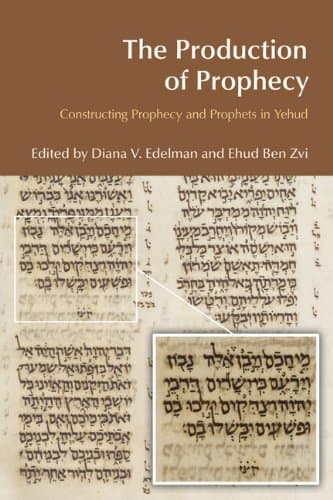
The Production of Prophecy.. Constructing Prophecy and Prophets in Yehud
إنتاج النبوة.. بناء النبوة والأنبياء في يهود
La production de la prophétie.. Construction de la prophétie et des prophètes dans le Yehud
Prophetic texts in the Hebrew Bible are not transparent records of historical prophets but literary and ideological constructs produced within the social and scribal context of Persian-period Yehud.
Editorial summary
This edited volume examines how prophecy and prophetic literature were constructed and reconstructed in Persian-period Yehud (approximately 539-332 BCE), offering critical insights into the social production of religious authority and divine communication. Edelman brings together contributors who analyze the literary, social, and ideological processes through which earlier prophetic traditions were reshaped to serve the needs of post-exilic communities.
The volume challenges traditional understandings of prophecy as spontaneous divine revelation by demonstrating how prophetic texts underwent deliberate editorial processes that reflected contemporary concerns about religious authority, communal identity, and divine presence. Contributors employ various forms of textual analysis to trace how pre-exilic prophetic materials were recontextualized, expanded, and sometimes fundamentally transformed during the Persian period. This approach reveals prophecy not as a fixed phenomenon but as a dynamic tradition continually reimagined by scribal communities.
Central to the volume's argument is the recognition that the construction of prophecy in Yehud served specific social functions. The essays demonstrate how prophetic texts were edited to address questions of theodicy arising from the exile, to legitimize the Second Temple cult, and to negotiate relationships with Persian imperial power. By examining redactional layers and literary strategies, contributors show how scribes retroactively shaped earlier prophets into figures who could speak to Persian-period concerns while maintaining claims to ancient authority.
The work engages significantly with debates about religious epistemology and the nature of divine communication. While not directly arguing for or against divine existence, the volume's historical-critical approach implicitly challenges naive readings of prophetic literature as unmediated divine speech. Instead, it presents prophecy as a complex cultural phenomenon involving human agency, literary creativity, and social negotiation. This perspective contributes to broader discussions about how religious traditions construct and validate claims to divine knowledge.
Edelman's collection represents an important contribution to understanding how religious communities produce and authorize sacred texts. By focusing on the mechanics of prophetic literature's formation, the volume illuminates the human processes underlying texts that claim divine origin. This work proves particularly valuable for scholars interested in how religious authority is constructed, maintained, and transformed across historical periods, offering insights relevant to contemporary debates about revelation, religious experience, and the relationship between human culture and divine communication.
Structured analysis
Argument formulations engaged
Edelman, Diana V. (2009). The Production of Prophecy.. Constructing Prophecy and Prophets in Yehud.
@book{the-production-of-prophecy-constructing-,
  author    = {Edelman, Diana V.},
  title     = {The Production of Prophecy.. Constructing Prophecy and Prophets in Yehud},
  year      = {2009},
  url       = {https://god-database.com/en/works/the-production-of-prophecy-constructing-prophecy-and-prophets-in-yehud}
}