
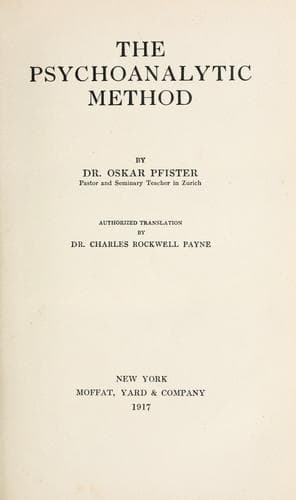
The Psychoanalytic Method
المنهج التحليلي النفسي
La Méthode psychanalytique
Editorial summary
Oskar Pfister's "The Psychoanalytic Method" (1917) represents a pioneering attempt to reconcile psychoanalytic theory with religious belief, challenging both the secular assumptions of early psychoanalysis and the anti-psychological stance of contemporary theology. Writing as both a Swiss Reformed pastor and practicing psychoanalyst, Pfister develops a distinctive approach that treats religious phenomena as legitimate expressions of human psychology while maintaining their spiritual significance.
The work directly engages with Freud's psychoanalytic framework, accepting its fundamental insights about the unconscious, repression, and psychological development while rejecting its reductionist treatment of religion. Pfister argues that psychoanalytic method, properly understood, reveals religion not as neurotic illusion but as a vital force for psychological health and moral development. He contends that genuine religious experience promotes ego integration and ethical maturity, distinguishing sharply between authentic faith and pathological religious manifestations.
Pfister's methodology combines clinical case studies with theological reflection, drawing extensively from his pastoral counseling practice. He demonstrates how psychoanalytic techniques can uncover and resolve religious conflicts without undermining faith itself. This approach positions him against both orthodox Freudians who dismiss religion as infantile wish-fulfillment and conservative theologians who reject psychological investigation of religious experience. His analysis particularly emphasizes how healthy religious development parallels psychological maturation, with mature faith characterized by reality acceptance rather than defensive fantasy.
The monograph's significance lies in establishing a mediating position in the emerging conflict between psychoanalysis and religion. Pfister maintains that psychological understanding enhances rather than diminishes authentic spirituality, arguing that neurotic distortions of religion require therapeutic intervention while genuine faith facilitates psychological wholeness. His work anticipates later developments in pastoral psychology and psychodynamic approaches to spirituality.
Writing within the early psychoanalytic movement while maintaining active correspondence with Freud himself, Pfister represents a unique voice advocating for the compatibility of depth psychology and religious commitment. His contribution matters for demonstrating that psychoanalytic method need not lead to atheistic conclusions, instead offering tools for distinguishing between pathological and healthy forms of religious life. The work thus provides an early model for integrating psychological insight with theological conviction, influencing subsequent efforts to develop psychologically informed approaches to pastoral care and religious experience.
Argument formulations engaged
Pfister, Oskar (1917). The Psychoanalytic Method.
@book{the-psychoanalytic-method-1917,
  author    = {Pfister, Oskar},
  title     = {The Psychoanalytic Method},
  year      = {1917},
  url       = {https://god-database.com/en/works/the-psychoanalytic-method-1917}
}