
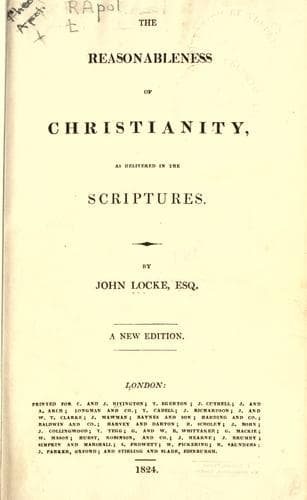
The Reasonableness of Christianity
معقولية المسيحية
Le Caractère raisonnable du christianisme
Editorial summary
Locke's The Reasonableness of Christianity represents a pivotal intervention in late seventeenth-century debates over religious authority, scriptural interpretation, and the rational grounds of faith. Writing in the aftermath of England's religious conflicts and amidst growing philosophical skepticism, Locke advances a minimalist Christianity centered on the single proposition that Jesus is the Messiah. This work demonstrates how rational inquiry can support rather than undermine religious belief, positioning itself against both rigid orthodoxy and emerging deist critiques.
The text systematically examines the New Testament to establish what constitutes essential Christian doctrine versus accumulated theological speculation. Locke argues that authentic Christianity requires only belief in Jesus as the promised Messiah and sincere repentance, making salvation accessible to all reasoning beings regardless of philosophical sophistication. This approach directly challenges the elaborate creeds and doctrinal requirements imposed by established churches, which Locke views as human additions obscuring Christianity's rational simplicity.
Methodologically, Locke employs careful scriptural exegesis combined with epistemological principles from his Essay Concerning Human Understanding. He distinguishes between propositions above reason and those contrary to reason, maintaining that genuine revelation never contradicts what natural reason can establish. This framework allows him to defend miracles and prophecy as divine attestations while rejecting mysterious doctrines that lack clear scriptural warrant or rational coherence.
The work's theological significance extends beyond its immediate context. Against enthusiasts who claimed direct divine inspiration, Locke insists on reason's role in evaluating purported revelations. Against skeptics who dismissed Christianity as priestcraft, he presents it as eminently reasonable. His argument that God would not make salvation dependent on complex metaphysical knowledge democratizes religious truth, aligning with his political liberalism.
Locke's influence reverberates through subsequent philosophy of religion. His emphasis on Christianity's rational core anticipates later natural theology while his scriptural methodology prefigures historical-critical approaches. Critics charged him with crypto-Socinianism for minimizing traditional doctrines like the Trinity, yet his sincere attempt to preserve Christianity's truth claims against both fundamentalism and skepticism establishes a middle path that shaped moderate Enlightenment thought. The work remains essential for understanding how modern thinkers sought to reconcile faith with reason, biblical authority with individual judgment, and religious commitment with philosophical inquiry.
Argument formulations engaged
Related works
Locke, John (1695). The Reasonableness of Christianity.
@book{the-reasonableness-of-christianity-1695,
  author    = {Locke, John},
  title     = {The Reasonableness of Christianity},
  year      = {1695},
  url       = {https://god-database.com/en/works/the-reasonableness-of-christianity-1695}
}