
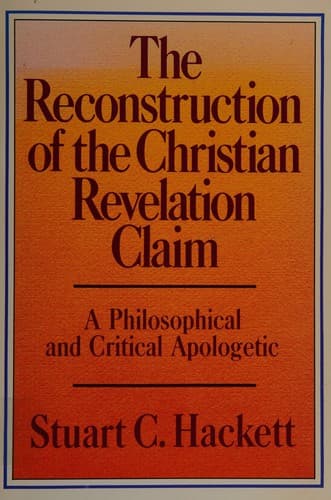
The Reconstruction of the Christian Revelation Claim: A Philosophical Assessment
إعادة بناء ادعاء الوحي المسيحي: تقييم فلسفي
La Reconstruction de la revendication de révélation chrétienne : Une évaluation philosophique
Editorial summary
This monograph presents a systematic philosophical defense of Christian revelation against modern skepticism and naturalistic challenges. Hackett develops a comprehensive framework for evaluating revelation claims through rigorous philosophical analysis, arguing that Christian theism provides the most coherent explanatory system for human existence and religious experience.
The work unfolds in three major movements. First, Hackett establishes epistemological foundations for assessing revelation claims, critiquing both empiricist reductionism and fideistic approaches that divorce faith from reason. He contends that religious knowledge requires neither abandonment of rational inquiry nor reduction to empirical verification alone. Instead, he proposes a critical realist epistemology that acknowledges both the legitimacy of metaphysical reasoning and the limitations of human cognition when approaching transcendent reality.
Second, the author examines competing worldviews, particularly naturalism and Eastern monism, demonstrating their internal inconsistencies and explanatory inadequacies. Against naturalism, Hackett argues that purely materialistic frameworks cannot account for consciousness, moral obligation, or the intelligibility of the universe itself. He challenges Eastern monistic systems by highlighting their inability to explain genuine personality, moral distinctions, and the reality of temporal existence. This comparative analysis serves to clear intellectual space for considering theistic alternatives.
The culminating section presents Hackett's positive case for Christian revelation. He argues that the Christian worldview uniquely satisfies key criteria for revelatory authenticity: internal coherence, explanatory comprehensiveness, existential adequacy, and historical grounding. Particularly significant is his treatment of the incarnation as philosophically intelligible rather than paradoxical, addressing standard objections about divine-human unity. Hackett maintains that Christian revelation provides resources for understanding both transcendence and immanence without sacrificing either divine otherness or genuine divine-world interaction.
Methodologically, Hackett employs analytical philosophy while engaging seriously with existentialist insights about human finitude and the personal dimension of religious commitment. His approach synthesizes rigorous logical analysis with phenomenological attention to lived experience. The work represents a sophisticated attempt to demonstrate that Christian revelation claims can withstand philosophical scrutiny while addressing perennial human questions about meaning, morality, and ultimate reality. This monograph contributes to late twentieth-century efforts to reestablish dialogue between philosophy and theology, challenging both the marginalization of religious discourse in academic philosophy and anti-intellectual trends within religious communities.
Argument formulations engaged
Hackett, Stuart C. (1984). The Reconstruction of the Christian Revelation Claim: A Philosophical Assessment. Baker Book House.
@book{the-reconstruction-of-the-christian-reve,
  author    = {Hackett, Stuart C.},
  title     = {The Reconstruction of the Christian Revelation Claim: A Philosophical Assessment},
  year      = {1984},
  publisher = {Baker Book House},
  url       = {https://god-database.com/en/works/the-reconstruction-of-the-christian-revelation-claim-a-philosophical-assessment-1984}
}