
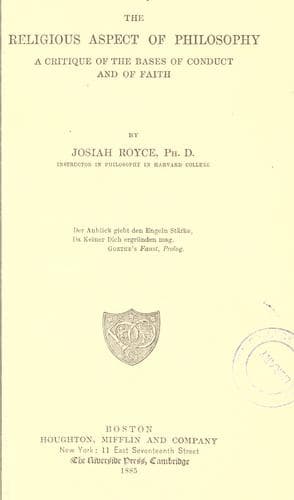
The Religious Aspect of Philosophy
الجانب الديني للفلسفة
L'Aspect religieux de la philosophie
Editorial summary
The Religious Aspect of Philosophy represents Josiah Royce's systematic attempt to demonstrate that genuine philosophical inquiry necessarily leads to religious insight, specifically to a form of absolute idealism that grounds both knowledge and morality in an infinite consciousness. Writing in 1885, Royce engages critically with the prevailing philosophical movements of his time—empiricism, positivism, and agnosticism—while developing a distinctively American contribution to post-Kantian idealism.
Royce begins by examining the skeptical challenges to religious belief posed by modern philosophy, particularly the claim that human knowledge cannot extend beyond finite experience. He argues that such skepticism, when pursued rigorously, undermines itself. The central innovation of the work lies in Royce's argument from error: the very possibility of error, he contends, presupposes an absolute standard of truth. When one judges that a belief is false, this judgment requires reference to what actually is the case—a complete, unified truth that transcends any finite perspective. This argument leads Royce to posit an Absolute Knower, an infinite consciousness that encompasses all reality and all truth.
The work systematically develops this insight through analyses of knowledge, moral obligation, and religious experience. Royce maintains that moral duties gain their categorical force only through their grounding in an absolute moral order, which itself requires the reality of God understood as the Absolute. Similarly, religious experience finds its validation not in subjective feeling but in its orientation toward this objective infinite reality.
Royce's methodology combines rigorous logical analysis with phenomenological attention to lived experience. He draws extensively on German idealism, particularly Hegel, while maintaining a characteristically pragmatic concern for the practical implications of philosophical theories. His critique targets not only materialistic and positivistic denials of God but also what he sees as the halfway measures of agnosticism and finite theism.
The significance of The Religious Aspect of Philosophy extends beyond its specific arguments. It establishes idealism as a major strand in American philosophy and provides a sophisticated philosophical defense of religious belief that avoids both dogmatism and relativism. Royce's work demonstrates how technical philosophy can address ultimate questions while maintaining intellectual rigor, influencing subsequent debates about the relationship between reason and faith in philosophers from William James to contemporary analytic philosophy of religion.
Argument formulations engaged
Related works
Royce, Josiah (1885). The Religious Aspect of Philosophy.
@book{the-religious-aspect-of-philosophy-1885,
  author    = {Royce, Josiah},
  title     = {The Religious Aspect of Philosophy},
  year      = {1885},
  url       = {https://god-database.com/en/works/the-religious-aspect-of-philosophy-1885}
}