
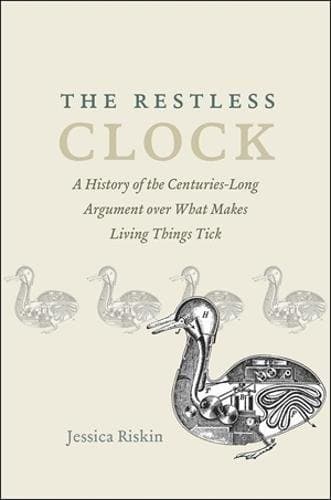
The Restless Clock
الساعة القلقة
L'Horloge agitée
Editorial summary
Jessica Riskin's "The Restless Clock" traces the historical development of mechanistic thinking in science and its implications for understanding life, consciousness, and divine agency. The work examines how early modern natural philosophers conceived of nature as clockwork while simultaneously preserving space for purposiveness and agency within mechanical systems. Riskin challenges the conventional narrative that mechanism necessarily expelled teleology and divine action from scientific explanation.
The study centers on what Riskin terms the "restless clock" tradition - a mechanistic worldview that paradoxically incorporated active, self-moving principles within ostensibly passive machinery. Through detailed historical analysis, she demonstrates how figures like Leibniz and Lamarck developed mechanistic theories that retained purposive elements, contrasting this with the "passive clock" model that emerged primarily in anglophone contexts through Boyle and Newton. This distinction proves crucial for understanding different approaches to reconciling mechanistic science with theological commitments.
Riskin's methodology combines intellectual history with close textual analysis of scientific and philosophical works from the seventeenth through nineteenth centuries. She traces how Continental natural philosophers maintained that mechanical systems could exhibit agency and purposiveness without requiring external divine intervention, while their British counterparts increasingly insisted on passive matter requiring God's constant supervision. This divergence shaped subsequent debates about evolution, consciousness, and the possibility of artificial life.
The work contributes significantly to understanding how mechanistic science relates to theological questions. Rather than viewing mechanism as inherently atheistic or deistic, Riskin shows how different mechanistic traditions embodied distinct theological commitments. The "restless clock" tradition suggested nature could be both mechanical and self-organizing, potentially limiting direct divine action while preserving teleology. The "passive clock" model, conversely, seemed to require more active divine involvement to explain apparent purposiveness in nature.
This historical analysis illuminates contemporary debates about emergence, consciousness, and design. Riskin demonstrates that current discussions about whether mechanistic explanation excludes purpose or agency recapitulate earlier theological controversies. Her work suggests that mechanism's relationship to religious belief depends less on mechanism itself than on which version of mechanism one adopts. By recovering the "restless clock" tradition, she opens conceptual space for reconciling naturalistic explanation with purposiveness, though without explicitly endorsing any particular theological position.
Argument formulations engaged
Riskin, Jessica (2016). The Restless Clock.
@book{the-restless-clock-2016,
  author    = {Riskin, Jessica},
  title     = {The Restless Clock},
  year      = {2016},
  url       = {https://god-database.com/en/works/the-restless-clock-2016}
}