
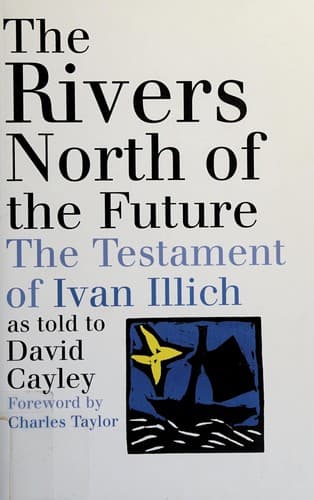
The Rivers North of the Future
الأنهار شمال المستقبل
Les Rivières au nord du futur
Editorial summary
This posthumously published collection of conversations between Ivan Illich and David Cayley explores the radical implications of Christian revelation for understanding modernity's institutional structures and their corruption of spiritual practices. Illich argues that modern Western institutions represent not merely secular developments but perverse inversions of Christian sacramental life, what he terms the "corruption of the best becoming the worst." The work presents a provocative theological critique suggesting that contemporary humanitarian systems, educational institutions, and even the church itself have transformed gospel freedom into mechanisms of control.
Central to Illich's analysis is his concept of the Incarnation as God's radical gift of freedom through personal encounter, which he contrasts with institutionalized Christianity's tendency to transform this gift into obligatory systems. He traces how the church's attempt to guarantee and manage divine grace through sacramental administration created the template for modern service institutions. This institutionalization, Illich contends, represents a fundamental betrayal of the gospel's anarchic message of love beyond law. His examination extends to how modern notions of care, education, and development function as secular continuations of corrupted Christian imperatives.
The work engages critically with conventional narratives of secularization, arguing that modernity remains deeply shaped by Christian categories even as it denies their theological grounding. Illich challenges both progressive Christian attempts to baptize modern institutions and secular critiques that fail to recognize their theological genealogy. His analysis draws on patristic sources, particularly the Eastern fathers, while engaging contemporary thinkers like Giorgio Agamben and Jacques Ellul to illuminate how Western civilization represents Christianity's shadow.
Illich's methodology combines historical genealogy with phenomenological analysis of lived experience, examining how abstract systems colonize personal relationships. He investigates specific practices like hospitality, learning, and healing to demonstrate how their institutionalization destroys precisely what they claim to preserve. The conversations reveal his conviction that recognizing God requires embracing contingency and refusing the certainties that institutions promise.
This work contributes to theological discourse by offering a radical critique of Christendom's legacy that neither embraces secular progressivism nor retreats into traditional orthodoxy. Illich's vision suggests that authentic faith requires recognizing how Christian revelation has been twisted into its opposite, calling for a recovery of the gospel's original strangeness. His analysis provides crucial insights for understanding how theological categories continue to structure supposedly secular modernity.
Argument formulations engaged
Illich, Ivan (2005). The Rivers North of the Future.
@book{the-rivers-north-of-the-future-2005,
  author    = {Illich, Ivan},
  title     = {The Rivers North of the Future},
  year      = {2005},
  url       = {https://god-database.com/en/works/the-rivers-north-of-the-future-2005}
}