
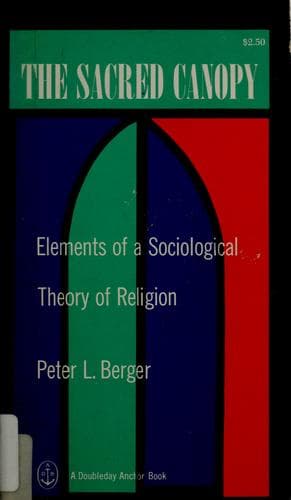
The Sacred Canopy
المظلة المقدسة
La Voûte sacrée
Editorial summary
Peter L. Berger's The Sacred Canopy presents a sociological analysis of religion's function in human society, particularly examining how religious worldviews create and maintain social order. Berger argues that religion serves as a "sacred canopy" - a overarching symbolic universe that shelters individuals and societies from the threat of meaninglessness and chaos. This canopy provides what he terms "nomos," a meaningful order that makes human existence comprehensible and bearable in the face of suffering, death, and uncertainty.
Central to Berger's analysis is the concept of "plausibility structures" - the social conditions that make particular beliefs seem reasonable or unreasonable to individuals. He contends that religious worldviews require specific social arrangements to remain credible. In traditional societies, where a single religious framework dominates, the sacred canopy remains intact because alternative interpretations of reality are absent or suppressed. The modern world, however, presents a radically different situation through what Berger identifies as pluralization - the coexistence of multiple competing worldviews within the same society.
This pluralistic condition fundamentally undermines religion's traditional role. When individuals encounter diverse belief systems as equally viable options, the taken-for-granted quality of any single religious worldview erodes. Berger argues that this leads to a "crisis of credibility" for religious institutions and beliefs. The sacred canopy becomes fragmented, forcing individuals to choose their worldview from a marketplace of options rather than inheriting it as an unquestioned reality.
Berger's work engages critically with both functionalist approaches to religion, which focus solely on religion's social utility, and theological approaches that ignore religion's sociological dimensions. He maintains that understanding religion requires examining both its subjective meaning for believers and its objective social functions. His analysis draws heavily on the phenomenological tradition, particularly the work of Alfred Schutz, while incorporating insights from Marx, Durkheim, and Weber.
The significance of The Sacred Canopy lies in its systematic explanation of secularization as a sociological process rather than an intellectual enlightenment. Berger demonstrates how modernization's structural features - urbanization, bureaucratization, and pluralization - create conditions that make traditional religious belief increasingly difficult to maintain. His work provides a sophisticated framework for understanding why religious authority has declined in modern societies without reducing this process to a simple narrative of scientific progress displacing religious ignorance.
Argument formulations engaged
Berger, Peter L. (1967). The Sacred Canopy.
@book{the-sacred-canopy-1967,
  author    = {Berger, Peter L.},
  title     = {The Sacred Canopy},
  year      = {1967},
  url       = {https://god-database.com/en/works/the-sacred-canopy-1967}
}