
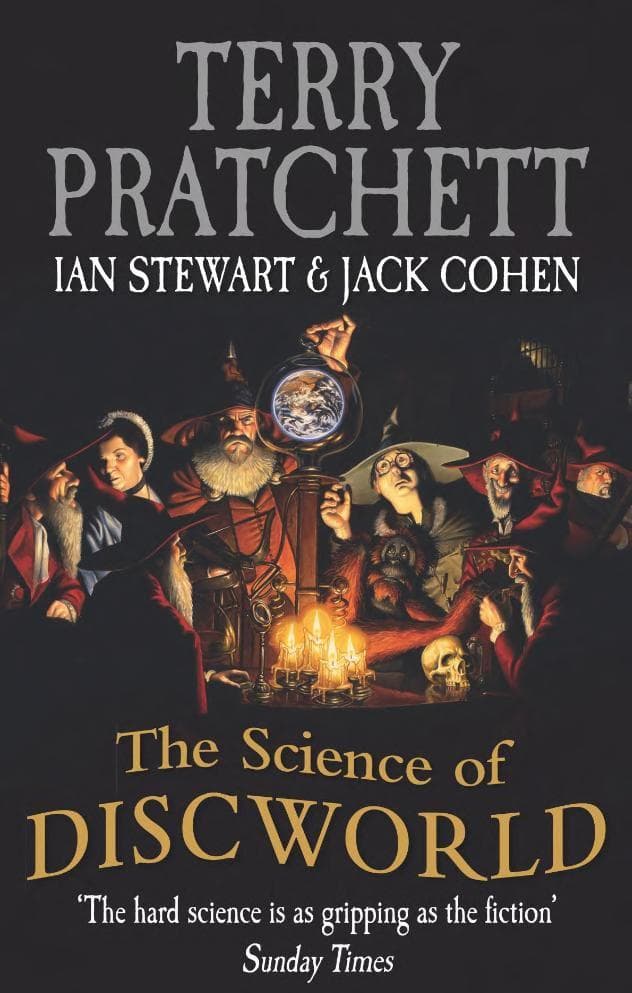
The Science of Discworld vol.1
علم عالم القرص المجلد الأول
La Science du Disque-monde vol.1
Science and narrative are complementary modes of understanding reality, and the scientific picture of the universe — from cosmology to evolution — challenges mythological and religious accounts of origins without necessarily replacing the human need for story.
Editorial summary
The Science of Discworld presents an innovative dialogue between fantasy literature and scientific explanation, using Terry Pratchett's fictional Discworld universe as a conceptual mirror for examining real-world science and its philosophical implications. Through alternating chapters of narrative fiction and scientific exposition, Pratchett, Stewart, and Cohen explore fundamental questions about the nature of reality, causation, and cosmic origins that bear directly on debates about divine design and purpose in the universe.
The work engages substantively with cosmological and fine-tuning arguments, though not through traditional philosophical argumentation but rather through what the authors call "lies-to-children" - simplified explanations that convey essential truths while acknowledging their own limitations. This approach allows them to address the apparent fine-tuning of physical constants and the origins of cosmic order without defaulting to either theistic design or purely mechanistic explanations. Instead, they develop a concept of "narrativium" - the human tendency to impose story-like patterns on natural phenomena - which serves as both a critique of anthropomorphic thinking about the universe and an acknowledgment of meaning-making as a fundamental human activity.
The authors' philosophy of science methodology emphasizes emergence, complexity, and the role of human cognition in constructing scientific understanding. They argue that the universe's apparent design features arise from the interplay of simple rules producing complex outcomes, rather than from intentional planning. This perspective challenges both naive design arguments and reductionist materialism, suggesting that questions about ultimate purpose may be artifacts of human narrative construction rather than features of reality itself.
The work's significance lies in its accessible yet sophisticated treatment of how scientific understanding relates to questions of cosmic purpose and design. By using fantasy fiction as a pedagogical tool, the authors create space for readers to examine their assumptions about causation, order, and meaning without the defensive reactions often triggered by direct theological or anti-theological arguments. Their approach demonstrates how scientific literacy can inform but not definitively resolve questions about ultimate reality and purpose. The text serves as a model for public engagement with science that neither dismisses religious questions nor accepts supernatural explanations, instead highlighting the creative tension between human meaning-making and scientific discovery.
Structured analysis
Argument formulations engaged
Pratchett, Terry - Stewart, Ian (2002). The Science of Discworld vol.1.
@book{the-science-of-discworld-vol1,
  author    = {Pratchett, Terry - Stewart, Ian},
  title     = {The Science of Discworld vol.1},
  year      = {2002},
  url       = {https://god-database.com/en/works/the-science-of-discworld-vol1}
}