
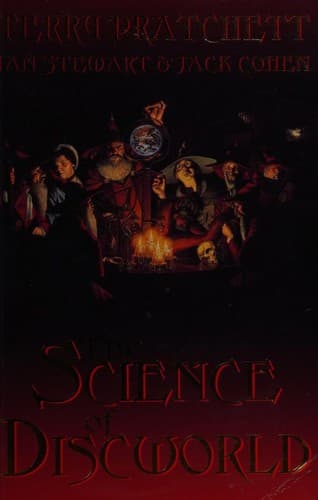
The Science of Discworld vol.4.. Judgement Day
علم عالم القرص المجلد الرابع.. يوم الحساب
La Science du Disque-monde vol.4.. Le Jour du jugement
Science and religion represent fundamentally different modes of understanding the world, and the conflict between them — dramatized through the fate of Discworld — reveals that scientific reasoning cannot be reconciled with supernaturalist claims without intellectual cost.
Editorial summary
This collaborative work between fantasy novelist Terry Pratchett, mathematician Ian Stewart, and biologist Jack Cohen employs the fictional framework of Discworld to explore fundamental questions about science, religion, and human judgment. The authors examine how scientific and religious worldviews approach questions of cosmic purpose and design, using their signature alternating structure of fantasy narrative and scientific exposition to illuminate contemporary debates about God's existence.
The book centers on a fictional trial in which the wizards of Unseen University must defend science against fundamentalist opposition, providing a narrative scaffold for examining real-world conflicts between scientific and religious explanations. Through this device, the authors analyze how humans construct meaning from observed patterns in nature, questioning whether apparent design necessitates a designer. They engage directly with contemporary iterations of the design argument, particularly addressing claims that biological complexity and cosmic fine-tuning point to divine intelligence.
The authors' philosophical approach draws heavily on evolutionary theory and complexity science to demonstrate how apparent design emerges from natural processes without requiring supernatural intervention. They examine how human cognitive biases toward pattern recognition and teleological thinking create predispositions to see purpose where none may exist. This analysis extends to fine-tuning arguments, where they explore anthropic reasoning and multiverse theories as alternatives to divine explanation for cosmic parameters conducive to life.
Methodologically, the work exemplifies public philosophy of science, making sophisticated arguments accessible through humor and narrative. The authors critique what they term "argument from personal incredulity," showing how both intelligent design proponents and fine-tuning advocates mistake human cognitive limitations for evidence of divine action. They emphasize science's self-correcting methodology versus religious certainty, while acknowledging that science cannot definitively disprove God's existence.
The book's significance lies in its innovative approach to perennial debates, using fiction to create emotional and intellectual distance that allows readers to reconsider entrenched positions. By embedding philosophical arguments within fantasy scenarios, the authors demonstrate how cultural narratives shape reasoning about ultimate questions. Their work contributes to understanding why design arguments persist despite scientific challenges, locating their appeal in human psychology rather than empirical evidence. This interdisciplinary synthesis offers valuable insights into how different epistemic frameworks approach questions of cosmic purpose and divine existence.
Structured analysis
Argument formulations engaged
Pratchett, Terry - Stewart, Ian (2013). The Science of Discworld vol.4.. Judgement Day.
@book{the-science-of-discworld-vol4-judgement-,
  author    = {Pratchett, Terry - Stewart, Ian},
  title     = {The Science of Discworld vol.4.. Judgement Day},
  year      = {2013},
  url       = {https://god-database.com/en/works/the-science-of-discworld-vol4-judgement-day}
}