
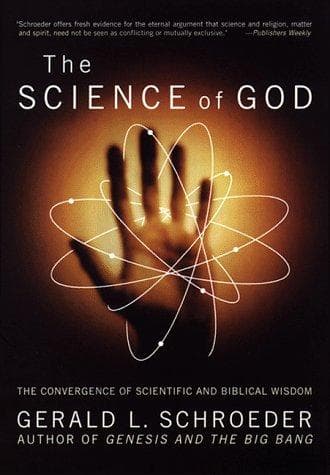
The Science of God: The Convergence of Scientific and Biblical Wisdom
علم الله: تقارب الحكمة العلمية والكتابية
La Science de Dieu : La convergence de la sagesse scientifique et biblique
Editorial summary
Schroeder's The Science of God presents an ambitious attempt to harmonize contemporary physics with biblical scripture, arguing that modern scientific discoveries actually confirm ancient Jewish wisdom rather than contradicting it. A physicist with doctoral training from MIT who later studied biblical commentary in Jerusalem, Schroeder brings both scientific expertise and religious scholarship to bear on questions of cosmic origins, time, consciousness, and divine action. His central thesis maintains that apparent conflicts between science and the Hebrew Bible arise from misinterpretations of both domains rather than genuine incompatibility.
The work's most distinctive contribution lies in its treatment of temporal relativity and creation. Schroeder argues that the six days of Genesis and the 15 billion years of cosmic history represent the same events viewed from different reference frames. Drawing on Einstein's relativity theory, he calculates that time dilation effects during the universe's expansion could reconcile these seemingly contradictory timescales. This approach differs markedly from both young-earth creationism and allegorical interpretations of Genesis, offering instead what Schroeder presents as a scientifically grounded literal reading.
Schroeder engages critically with scientific materialism, particularly targeting what he sees as the inadequacy of purely naturalistic explanations for consciousness, the fine-tuning of physical constants, and the origin of biological information. He draws extensively on quantum mechanics, thermodynamics, and molecular biology to argue that scientific evidence points toward purposeful design rather than random processes. His treatment of evolution accepts common descent while maintaining that random mutation and natural selection alone cannot account for biological complexity.
The book addresses a general educated audience rather than specialists, attempting to make both scientific concepts and biblical exegesis accessible to non-experts. Schroeder positions his work against both fundamentalist readings that reject scientific evidence and secular approaches that dismiss religious texts as pre-scientific mythology. His methodology combines scientific calculation with medieval Jewish commentaries, particularly drawing on Maimonides and Nachmanides.
While some critics question Schroeder's selective use of scientific data and his interpretations of biblical Hebrew, his work represents a significant entry in science-religion dialogue from an Orthodox Jewish perspective. The book's influence extends beyond religious communities, contributing to broader discussions about the relationship between scientific and religious truth claims in contemporary thought.
Argument formulations engaged
Related works
Schroeder, Gerald (1997). The Science of God: The Convergence of Scientific and Biblical Wisdom.
@book{the-science-of-god-the-convergence-of-sc,
  author    = {Schroeder, Gerald},
  title     = {The Science of God: The Convergence of Scientific and Biblical Wisdom},
  year      = {1997},
  url       = {https://god-database.com/en/works/the-science-of-god-the-convergence-of-scientific-and-biblical-wisdom-1997}
}