
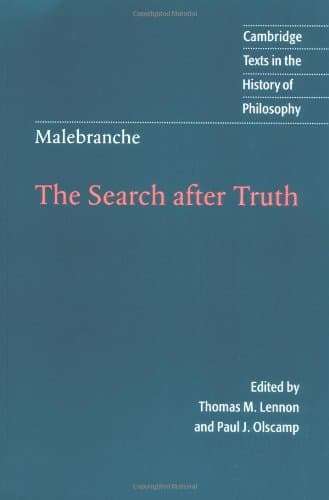
The Search after Truth
البحث عن الحقيقة
La Recherche de la vérité
Editorial summary
Malebranche's The Search after Truth presents a systematic philosophical investigation into the nature of human knowledge and its proper objects, ultimately arguing that genuine understanding depends upon seeing all things in God. This work develops a distinctive synthesis of Cartesian philosophy and Augustinian theology, proposing that human minds perceive truths not through their own natural capacities but through a direct intellectual vision of ideas as they exist in the divine intellect.
The treatise begins by cataloguing the various sources of error that plague human cognition, analyzing how the senses, imagination, and passions systematically mislead the understanding. Malebranche argues that the fall has corrupted human faculties, making them unreliable guides to truth. He demonstrates how sensory experience provides only confused modifications of the soul rather than genuine knowledge of external objects. This critique extends to the imagination and emotions, which he shows generate prejudices and false judgments that further obscure reality.
Against this backdrop of human cognitive limitation, Malebranche develops his central doctrine of vision in God. He contends that when humans perceive eternal truths, mathematical principles, or the essences of things, they do not access ideas stored in their own minds but rather participate in God's own eternal ideas. This theory addresses the problem of how finite minds can grasp infinite and necessary truths. For Malebranche, God serves as the immediate object of all genuine intellectual perception, making divine illumination the foundation of all knowledge.
The work situates itself against both scholastic Aristotelianism and materialist accounts of cognition. Malebranche rejects the notion that knowledge comes through abstraction from sensible species, as well as any suggestion that material processes alone can account for intellectual understanding. His occasionalism, which denies genuine causal efficacy to creatures, reinforces this vision by making God the only true cause of both physical events and mental perceptions.
The Search after Truth's significance for debates about God lies in its radical integration of epistemology and theology. By making God epistemologically indispensable for any act of genuine understanding, Malebranche provides a philosophical argument for divine existence based on the very possibility of knowledge. His system demonstrates how Cartesian philosophical principles, when pressed to their logical conclusions, lead not to deism or religious skepticism but to an intensified awareness of humanity's continuous dependence upon God for both being and knowing.
Argument formulations engaged
Related works
Malebranche, Nicolas (1674). The Search after Truth.
@book{the-search-after-truth-1674,
  author    = {Malebranche, Nicolas},
  title     = {The Search after Truth},
  year      = {1674},
  url       = {https://god-database.com/en/works/the-search-after-truth-1674}
}