
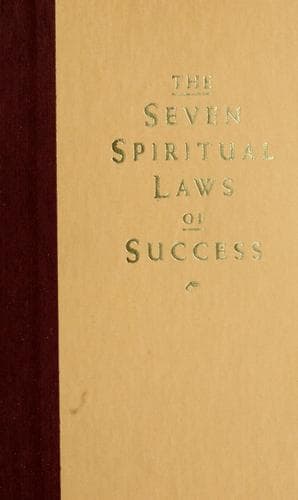
The Seven Spiritual Laws of Success
القوانين الروحية السبعة للنجاح
Les Sept Lois spirituelles du succès
Editorial summary
Deepak Chopra's "The Seven Spiritual Laws of Success" presents a synthesis of Eastern spiritual philosophy and Western self-help methodology, offering a framework that grounds personal achievement in cosmic consciousness. The work articulates seven principles derived from Vedantic and Buddhist traditions, recontextualizing ancient spiritual wisdom for contemporary readers seeking both material prosperity and spiritual fulfillment.
Chopra's central argument posits that success flows naturally from alignment with universal spiritual laws rather than through forceful striving. The seven laws—ranging from the Law of Pure Potentiality to the Law of Dharma—constitute a systematic approach to harmonizing individual consciousness with what Chopra terms the "field of infinite possibilities." This field represents an impersonal divine intelligence that governs cosmic operations and human potential alike.
The work engages critically with conventional Western paradigms of achievement that emphasize competition, struggle, and ego-driven ambition. Against these models, Chopra advances a non-dualistic understanding where the divine exists not as a transcendent deity but as the fundamental consciousness underlying all reality. Individuals access this consciousness through meditation, present-moment awareness, and recognition of their essential unity with the cosmic whole.
Methodologically, Chopra employs accessible analogies from quantum physics alongside traditional Sanskrit concepts, creating a hybrid discourse that attempts to bridge scientific and spiritual vocabularies. This approach reflects his broader project of legitimating Eastern spirituality through selective appropriation of scientific terminology, though critics note the work lacks rigorous philosophical argumentation or empirical substantiation.
The text's significance lies primarily in its popularization of neo-Vedantic concepts within Western culture, particularly its reconfiguration of the divine as an accessible inner resource rather than an external authority. Chopra transforms traditional Hindu concepts of karma, dharma, and moksha into practical principles for daily living, effectively democratizing esoteric teachings while arguably diluting their original theological complexity.
For academic discourse on divinity, the work exemplifies how contemporary spiritual movements reconceptualize the sacred in psychological and energetic terms, moving away from personal theism toward impersonal cosmic consciousness. This shift represents a broader trend in New Age spirituality that seeks to preserve notions of the divine while avoiding traditional religious structures and doctrinal commitments. The text thus contributes to understanding how modern Western audiences negotiate between secular materialism and spiritual meaning-making.
Argument formulations engaged
Chopra, Deepak (1994). The Seven Spiritual Laws of Success. Amber-Allen Publishing.
@book{the-seven-spiritual-laws-of-success-1994,
  author    = {Chopra, Deepak},
  title     = {The Seven Spiritual Laws of Success},
  year      = {1994},
  publisher = {Amber-Allen Publishing},
  url       = {https://god-database.com/en/works/the-seven-spiritual-laws-of-success-1994}
}