
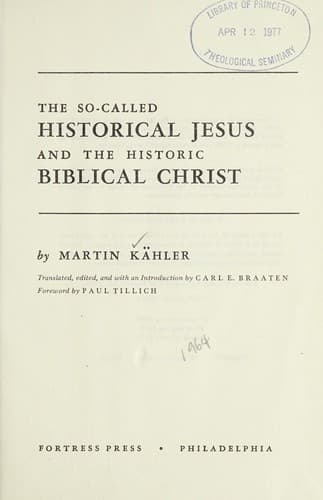
The So-Called Historical Jesus and the Historic Biblical Christ
يسوع التاريخي المزعوم والمسيح التوراتي التاريخي
Le Soi-disant Jésus historique et le Christ biblique historique
Editorial summary
Martin Kähler's monograph represents a watershed moment in theological methodology, challenging the prevailing nineteenth-century quest for the historical Jesus. Writing against the dominant liberal Protestant scholarship of his era, Kähler argues that attempts to reconstruct Jesus through historical-critical methods fundamentally misunderstand the nature of the Gospel sources and the essence of Christian faith. His central thesis distinguishes between the "so-called historical Jesus" pursued by scholarly reconstruction and the "historic biblical Christ" proclaimed in the New Testament and experienced by believers.
Kähler contends that the Gospel writers never intended to provide biographical material suitable for modern historical analysis. Rather, they composed testimonies of faith, presenting Christ as the object of belief and worship. The text demonstrates how attempts to strip away supposed mythological accretions to reach a purely human Jesus behind the texts inevitably fail, as scholars project their own philosophical presuppositions onto fragmentary evidence. Each reconstruction reflects more about its author's worldview than about the actual Jesus of Nazareth.
The work's methodological significance lies in its epistemological critique. Kähler argues that faith cannot depend on the shifting results of historical scholarship, which remain perpetually provisional and accessible only to educated elites. Instead, authentic knowledge of Christ comes through the church's proclamation and the believer's encounter with the living Christ mediated through Scripture. This position anticipates twentieth-century developments in hermeneutics and the theology of revelation.
Kähler's influence extends far beyond his immediate context. His critique shaped dialectical theology, particularly Karl Barth's emphasis on the Word of God as divine self-revelation rather than human discovery. The distinction between Historie (mere historical facts) and Geschichte (meaningful history) became central to subsequent theological reflection. His work also prefigures later scholarly recognition that the Gospels are primarily kerygmatic rather than biographical texts.
The monograph's enduring contribution to discussions about God lies in its reconfiguration of how theological knowledge is obtained and validated. By arguing that the Christ of faith cannot be separated from the Jesus of history because the latter is inaccessible through purely historical methods, Kähler shifts the theological focus from historical reconstruction to the reality of divine revelation in Christ. This move protects Christian claims about God's self-disclosure from reduction to merely human categories while maintaining the historical givenness of the incarnation.
Argument formulations engaged
Kähler, Martin (1896). The So-Called Historical Jesus and the Historic Biblical Christ. Fortress Press, Philadelphia, Pa..
@book{the-so-called-historical-jesus-and-the-h,
  author    = {Kähler, Martin},
  title     = {The So-Called Historical Jesus and the Historic Biblical Christ},
  year      = {1896},
  publisher = {Fortress Press, Philadelphia, Pa.},
  url       = {https://god-database.com/en/works/the-so-called-historical-jesus-and-the-historic-biblical-christ-1896}
}