
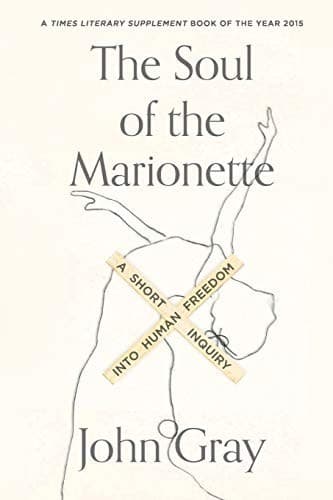
The Soul of the Marionette: A Short Inquiry into Human Freedom
روح الدمية المتحركة: بحث قصير في الحرية البشرية
L'Âme de la marionnette : Une brève enquête sur la liberté humaine
Editorial summary
John Gray's The Soul of the Marionette presents a provocative challenge to secular humanist assumptions about human freedom and progress. This philosophical meditation dismantles the widespread belief that scientific rationalism has liberated humanity from religious illusion, arguing instead that modern secular thought perpetuates theological patterns while denying their origin. Gray's analysis bears directly on contemporary debates about God by exposing how ostensibly atheistic worldviews remain saturated with crypto-religious assumptions about human nature and destiny.
The work develops through an examination of the Gnostic tradition and its persistence in secular form. Gray contends that ancient Gnostic themes - the belief in hidden knowledge that can liberate humans from material constraints, the conviction that humans possess a divine spark distinguishing them from nature - survive intact within modern progressive ideologies. He traces these patterns through Enlightenment philosophy, scientific materialism, and contemporary transhumanism, demonstrating how each reproduces essentially religious narratives while claiming to have transcended religion itself.
Central to Gray's argument is his critique of free will as a Christian theological concept that atheist humanists have unconsciously preserved. He draws on neuroscience, evolutionary psychology, and determinist philosophy to argue that human freedom is largely illusory, yet notes how secular thinkers resist this conclusion with quasi-religious fervor. This analysis directly engages new atheist claims about human autonomy and moral progress, suggesting figures like Sam Harris and Steven Pinker remain trapped within Christian anthropological assumptions they explicitly reject.
Gray's methodology combines intellectual history with philosophical analysis, moving fluidly between ancient texts and contemporary debates. His erudite yet accessible style connects Kleist's essay on marionettes, Philip K. Dick's science fiction, and Buddhist philosophy to illuminate how the "puppet" metaphor captures human existence more accurately than humanist notions of autonomous selfhood. The work functions as both a genealogy of secular religion and a meditation on the human condition.
The significance for God-discourse lies in Gray's demonstration that rejecting traditional theism does not necessarily escape theological thinking. His argument suggests that honest atheism must confront its own religious inheritances and accept a more modest, potentially nihilistic view of human nature. While not defending theism, Gray's work profoundly destabilizes confident secular narratives about reason, progress, and human dignity that underpin much contemporary atheist thought.
Argument formulations engaged
Gray, John (2015). The Soul of the Marionette: A Short Inquiry into Human Freedom. Allen Lane.
@book{the-soul-of-the-marionette-a-short-inqui,
  author    = {Gray, John},
  title     = {The Soul of the Marionette: A Short Inquiry into Human Freedom},
  year      = {2015},
  publisher = {Allen Lane},
  url       = {https://god-database.com/en/works/the-soul-of-the-marionette-a-short-inquiry-into-human-freedom-2015}
}