
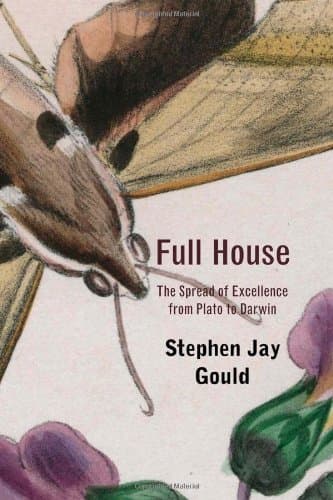
The Spread of Excellence from Plato to Darwin
انتشار التميز من أفلاطون إلى داروين
La Diffusion de l'excellence de Platon à Darwin
Gould argues that the notion of 'excellence' or directional progress from Plato through Darwin is a conceptual illusion imposed on nature, and that evolution operates through variation and contingency rather than teleological improvement.
Editorial summary
This work examines how concepts of perfection and excellence have evolved from ancient philosophy through modern evolutionary theory, revealing fundamental shifts in how Western thought conceives of order, hierarchy, and the divine. Gould traces the transformation from Plato's transcendent Forms to Darwin's naturalistic mechanisms, demonstrating how the locus of excellence migrated from metaphysical realms to material processes.
The analysis begins with Platonic philosophy, where excellence derives from participation in eternal, perfect Forms. In this framework, the material world represents mere shadows of divine archetypes, with degrees of excellence corresponding to proximity to transcendent ideals. Gould shows how this vertical hierarchy, pointing upward toward divine perfection, dominated Western thought through medieval scholasticism, where Aristotelian teleology merged with Christian theology to create the Great Chain of Being.
The work then tracks the gradual naturalization of excellence through early modern science. Gould examines how Enlightenment thinkers began locating perfection within nature's laws rather than beyond them, though often retaining theological frameworks. The crucial transformation comes with Darwin, who radically reconceptualized excellence as adaptive fitness within specific environments rather than approximation to ideal types.
Gould's methodology combines intellectual history with philosophical analysis, carefully documenting how scientific discoveries forced reconceptualizations of fundamental categories. He demonstrates that Darwin's theory didn't merely challenge specific religious claims but undermined the entire Platonic-Christian framework of transcendent perfection. Excellence becomes horizontal rather than vertical, contextual rather than absolute, emergent rather than imposed.
The work engages cosmological arguments by showing how evolutionary theory eliminates the need for divine design to explain apparent purposiveness in nature. Where traditional natural theology saw evidence of God in nature's excellence, Darwin revealed mechanical processes sufficient to generate complexity without intention. Gould's conceptual clarification reveals how terms like "perfection" and "progress" carry hidden metaphysical assumptions that evolutionary theory exposes and challenges.
This historical analysis illuminates contemporary debates about naturalism and theism by revealing their deep conceptual roots. Gould shows that conflicts between evolution and religion often stem from incompatible frameworks for understanding excellence itself. His work suggests that accepting evolutionary theory requires abandoning not just specific theological claims but entire ways of conceptualizing value, purpose, and order inherited from Platonic-Christian tradition.
Argument formulations engaged
Gould, Stephen Jay (1996). The Spread of Excellence from Plato to Darwin. Belknap Press of Harvard University Press.
@book{the-spread-of-excellence-from-plato-to-d,
  author    = {Gould, Stephen Jay},
  title     = {The Spread of Excellence from Plato to Darwin},
  year      = {1996},
  publisher = {Belknap Press of Harvard University Press},
  url       = {https://god-database.com/en/works/the-spread-of-excellence-from-plato-to-darwin}
}