
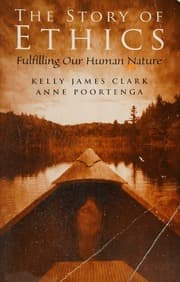
The Story of Ethics: Fulfilling Our Human Nature
قصة الأخلاق: إتمام طبيعتنا البشرية
L'Histoire de l'éthique : Accomplir notre nature humaine
Editorial summary
This monograph presents a comprehensive defense of theistic ethics grounded in natural law theory and virtue ethics. Clark develops a sophisticated philosophical framework that integrates insights from Aristotelian-Thomistic tradition with contemporary moral philosophy to argue that ethical living fundamentally requires recognition of humanity's relationship to God. The work stands as a significant contribution to debates about moral foundations and the necessity of religious grounding for objective ethics.
The author's central thesis maintains that human beings possess an inherent telos or purpose that can only be properly understood and fulfilled within a theistic framework. Clark systematically examines how moral obligations emerge from human nature itself, but argues that this nature points beyond mere biological or social facts to a transcendent source. He contends that attempts to ground ethics in purely naturalistic terms fail to account for the categorical nature of moral demands and the ultimate significance of ethical choices.
Clark's methodology combines careful conceptual analysis with engagement of both historical and contemporary sources. He traces the development of virtue ethics from Aristotle through Aquinas, demonstrating how medieval thinkers successfully integrated Greek philosophical insights with monotheistic theology. The work then addresses modern challenges from evolutionary ethics, moral relativism, and secular humanism, arguing that each ultimately collapses into incoherence or arbitrary preference without theistic foundations.
A particularly notable contribution involves Clark's treatment of the relationship between human flourishing and divine commands. Rather than presenting these as competing sources of moral authority, he develops a unified account where God's commands flow from divine wisdom about human nature and its proper fulfillment. This approach addresses standard Euthyphro-style objections while maintaining the objectivity of moral truth.
The monograph engages critically with prominent secular ethicists including Peter Singer, Christine Korsgaard, and Richard Joyce, demonstrating how their projects inadvertently rely on theistic assumptions or fail to provide adequate justification for moral normativity. Clark's analysis reveals how attempts to preserve objective morality while rejecting its religious foundations lead to unstable halfway houses.
This work advances God-debate discussions by providing a philosophically rigorous case that ethics requires theological grounding, not as an external imposition but as the natural completion of moral reasoning. Clark's integration of classical natural law theory with contemporary metaethics offers religious thinkers sophisticated tools for engaging secular moral philosophy while demonstrating to skeptics that theistic ethics need not rely on mere divine command theory.
Argument formulations engaged
Clark, Kelly James (2004). The Story of Ethics: Fulfilling Our Human Nature. Prentice Hall.
@book{the-story-of-ethics-fulfilling-our-human,
  author    = {Clark, Kelly James},
  title     = {The Story of Ethics: Fulfilling Our Human Nature},
  year      = {2004},
  publisher = {Prentice Hall},
  url       = {https://god-database.com/en/works/the-story-of-ethics-fulfilling-our-human-nature-2004}
}