
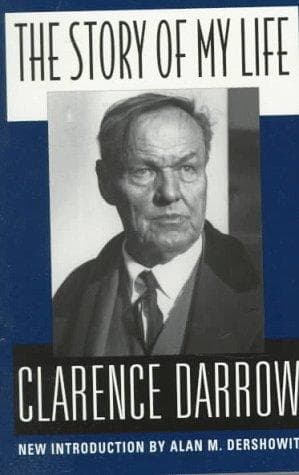
The Story of My Life
قصة حياتي
L'Histoire de ma vie
Editorial summary
Clarence Darrow's autobiography "The Story of My Life" presents a sustained critique of religious belief through the lens of personal experience and legal advocacy. Written near the end of his career, the work reflects on decades of courtroom battles and public debates that positioned Darrow as one of America's most prominent skeptics of organized religion and theological claims.
The text employs a narrative approach that interweaves personal anecdotes with philosophical reflections on the nature of belief, morality, and human reason. Darrow traces his journey from a conventional religious upbringing to his eventual rejection of supernatural explanations for natural phenomena. His account emphasizes the role of scientific understanding and empirical observation in displacing religious frameworks, arguing that increased knowledge invariably leads to decreased faith. The work particularly focuses on his experiences defending scientific education and challenging religious orthodoxy in landmark cases, most notably the Scopes trial of 1925.
Darrow's method combines legal reasoning with popular philosophy, making sophisticated arguments about determinism, free will, and moral responsibility accessible to general readers. He contends that religious belief stems primarily from fear of death and ignorance of natural causes, positioning himself against both fundamentalist Christianity and more liberal theological positions that attempt to reconcile faith with modern science. His critique extends beyond specific doctrines to challenge the very concept of divine providence and supernatural intervention in human affairs.
The autobiography contributes to early twentieth-century debates about secularization and the proper role of religion in public life. Darrow argues that moral behavior requires no religious foundation and that ethical systems based on human welfare and rational consideration prove superior to those grounded in divine command. He addresses contemporary theologians and religious apologists who sought to modernize faith in response to scientific challenges, dismissing their efforts as intellectually dishonest compromises.
The work's significance lies in its articulation of pragmatic atheism from within American cultural discourse. Unlike European philosophical atheism, Darrow's skepticism emerges from practical experience with law, social reform, and democratic institutions. His autobiography demonstrates how rejection of religious belief could align with progressive politics and humanitarian concerns, challenging assumptions that atheism necessarily leads to nihilism or moral decay. The text remains influential as a document of American freethought and as testimony to the possibility of meaningful life without religious faith.
Argument formulations engaged
Darrow, Clarence (1932). The Story of My Life. Aegitas.
@book{the-story-of-my-life-1932,
  author    = {Darrow, Clarence},
  title     = {The Story of My Life},
  year      = {1932},
  publisher = {Aegitas},
  url       = {https://god-database.com/en/works/the-story-of-my-life-1932}
}