
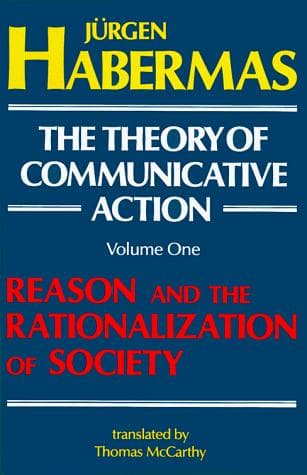
The Theory of Communicative Action
نظرية الفعل التواصلي
La Théorie de l'action communicationnelle
Editorial summary
Jürgen Habermas's The Theory of Communicative Action represents a landmark attempt to reconstruct critical social theory without recourse to theological or metaphysical foundations. This two-volume work, originally published in German in 1981, articulates a post-metaphysical framework for understanding rationality, meaning, and social integration that deliberately sidesteps traditional questions about divine authority or transcendent grounds of validity.
Habermas develops his theory through a systematic engagement with the history of social thought, particularly Max Weber's account of modernization as rationalization and disenchantment. Where Weber pessimistically diagnosed the loss of meaning following the decline of religious worldviews, Habermas argues that communicative rationality itself provides sufficient resources for social coordination and normative critique. His central claim is that the validity basis of speech—the implicit claims to truth, rightness, and sincerity raised in communication—can ground both social integration and critical standards without appeal to sacred or absolute foundations.
The work explicitly positions itself within what Habermas calls the "post-metaphysical" condition of modernity. Religious and metaphysical worldviews, he argues, have been "linguistified"—their cognitive contents translated into fallible, publicly criticizable claims. This process of rationalization does not eliminate religion but transforms it into one voice among many in public discourse. Habermas traces this development through detailed reconstructions of Mead's symbolic interactionism and Durkheim's theory of the sacred, showing how the binding force once attributed to the holy migrates into the structures of communicative action itself.
This argument has significant implications for debates about secularization and the role of religion in modern societies. Against both defenders of religious tradition and radical secularists, Habermas charts a middle course that acknowledges religion's continued social relevance while denying its claim to privileged epistemic authority. His theory suggests that modern societies can achieve integration through rational discourse rather than shared sacred beliefs, though he later acknowledges that religious traditions may contain "semantic potentials" not yet fully translated into secular discourse.
The Theory of Communicative Action thus contributes to the God debate primarily through its systematic articulation of a post-religious foundation for social theory. By demonstrating how validity, meaning, and solidarity can emerge from communicative practice itself, Habermas provides a sophisticated alternative to both theological grounding and nihilistic relativism.
Argument formulations engaged
Related works
Habermas, Jürgen (1981). The Theory of Communicative Action. Beacon Press.
@book{the-theory-of-communicative-action-1981,
  author    = {Habermas, Jürgen},
  title     = {The Theory of Communicative Action},
  year      = {1981},
  publisher = {Beacon Press},
  url       = {https://god-database.com/en/works/the-theory-of-communicative-action-1981}
}