
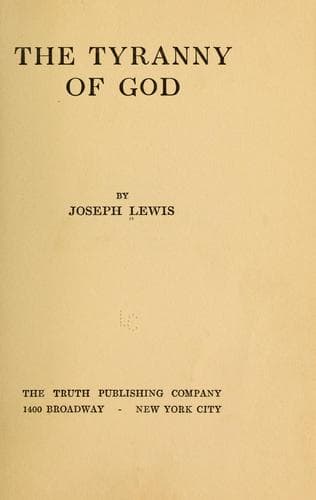
The Tyranny of God
طغيان الله
La Tyrannie de Dieu
Editorial summary
This provocative monograph represents a fierce polemic against religious belief, particularly Christian theism, characteristic of early twentieth-century American freethought. Lewis mounts a comprehensive attack on the concept of God, arguing that belief in a divine being constitutes a form of intellectual and moral tyranny that humanity must overcome to achieve genuine freedom and progress.
The work systematically dismantles traditional arguments for God's existence while cataloguing what Lewis perceives as the harmful consequences of religious faith throughout history. Drawing on Enlightenment rationalism and the emerging scientific materialism of his era, Lewis contends that the God concept represents a primitive anthropomorphic projection that science has rendered obsolete. He argues that attributing natural phenomena to divine agency reflects pre-scientific ignorance, and that moral systems based on divine command theory perpetuate arbitrary and often cruel standards that impede human flourishing.
Lewis employs a rhetorical strategy combining philosophical critique with historical examples of religious persecution, war, and suppression of scientific inquiry. He particularly emphasizes how belief in God has been used to justify political oppression and social inequality, viewing religion as an instrument of control wielded by ruling classes against the masses. The author draws extensively on the works of earlier critics like Voltaire, Thomas Paine, and Robert Ingersoll, while incorporating contemporary biblical criticism that challenges traditional views of scriptural authority.
The monograph's significance lies in its representation of militant atheism during a period of intense cultural conflict between religious traditionalism and secular modernism in America. Lewis writes amid the fundamentalist-modernist controversy, positioning his work as a radical alternative to both conservative religion and liberal attempts at reconciliation between faith and reason. His uncompromising stance reflects the confidence of early twentieth-century rationalists who believed science would inevitably triumph over religious superstition.
While Lewis's arguments often lack philosophical sophistication by contemporary standards, relying heavily on rhetorical flourish and selective historical examples, the work remains valuable as a historical document illuminating the intellectual climate of American secularism in the 1920s. It exemplifies the combative style of popular atheist literature that would influence later critics of religion, demonstrating how anti-religious polemic functioned as a form of cultural criticism challenging established social hierarchies and advocating for a thoroughly naturalistic worldview.
Argument formulations engaged
Lewis, Joseph (1921). The Tyranny of God.
@book{the-tyranny-of-god-1921,
  author    = {Lewis, Joseph},
  title     = {The Tyranny of God},
  year      = {1921},
  url       = {https://god-database.com/en/works/the-tyranny-of-god-1921}
}