
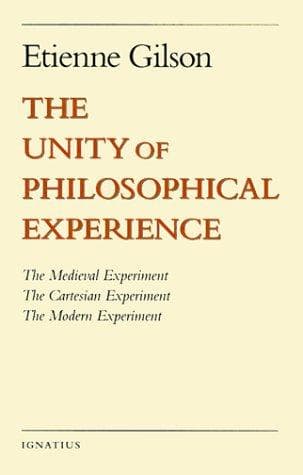
The Unity of Philosophical Experience
وحدة التجربة الفلسفية
L'Unité de l'expérience philosophique
Editorial summary
This work examines the historical development of philosophical thought through a distinctly Thomistic lens, arguing that philosophy repeatedly falls into error when it abandons its proper metaphysical foundations. Gilson traces three major philosophical "experiments" across history—the medieval transition from theology to logic, the early modern shift from metaphysics to physics, and the modern turn from physics to psychology—demonstrating how each represents a fundamental methodological mistake that ultimately leads to skepticism and philosophical bankruptcy.
The author employs a historical-critical method that combines careful textual analysis with philosophical diagnosis. By examining figures such as Abelard, Ockham, Descartes, Malebranche, Hume, and Kant, Gilson illustrates how philosophers who reduce philosophy to a single dimension inevitably encounter insurmountable contradictions. His central thesis maintains that authentic philosophy requires a proper understanding of being qua being, and that attempts to ground philosophy in logic, mathematics, physics, or psychology alone inevitably fail because they mistake a part for the whole.
The work's significance for the God debate emerges through its defense of natural theology and its critique of philosophical positions that render knowledge of God impossible. Gilson argues that the abandonment of proper metaphysics leads directly to the denial of our capacity to know God through reason. He particularly targets nominalism for destroying the metaphysical basis of divine attributes, Cartesian rationalism for reducing God to a geometric axiom, and Kantian criticism for making God merely a regulative idea. Against these positions, he advocates for a return to the realist metaphysics of Aquinas, which preserves both the transcendence of God and the possibility of analogical knowledge about divine nature.
The text serves as both a historical study and a philosophical argument, demonstrating that the "unity" of philosophical experience lies not in shared conclusions but in the recurring pattern of error when philosophy strays from its proper metaphysical object. Gilson's work thus presents itself as a vindication of the perennial philosophy, showing how the Thomistic synthesis provides resources for avoiding the skeptical outcomes that plague modern thought. His analysis suggests that philosophical positions on God's existence and nature depend fundamentally on prior metaphysical commitments, and that only a philosophy grounded in the act of existence itself can adequately address theological questions.
Argument formulations engaged
Related works
Gilson, Etienne (1937). The Unity of Philosophical Experience. Philosophy Documentation Center.
@book{the-unity-of-philosophical-experience-19,
  author    = {Gilson, Etienne},
  title     = {The Unity of Philosophical Experience},
  year      = {1937},
  publisher = {Philosophy Documentation Center},
  url       = {https://god-database.com/en/works/the-unity-of-philosophical-experience-1937}
}