
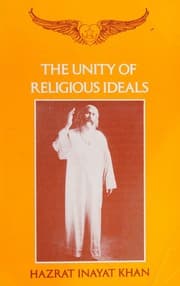
The Unity of Religious Ideals
وحدة المثل الدينية
L'Unité des idéaux religieux
Editorial summary
This monograph presents a comprehensive exposition of Sufi universalism, arguing that all major religious traditions emanate from a single divine source and ultimately convey the same essential spiritual truths. Khan develops this thesis through a systematic examination of common themes across world religions, including concepts of deity, prophetic revelation, moral teachings, and mystical experience. The work represents a significant contribution to perennialist philosophy and interfaith dialogue, offering a mystical interpretation of religious diversity that seeks to reconcile apparent contradictions between different faith traditions.
Khan's methodology combines traditional Sufi hermeneutics with comparative religious analysis. He interprets religious differences as superficial variations arising from cultural, linguistic, and historical contexts, while maintaining that the underlying spiritual reality remains constant across all authentic religious expressions. The author draws extensively from Islamic mystical tradition, particularly the concept of wahdat al-wujud (unity of being), but extends this framework to encompass Hindu, Buddhist, Jewish, Christian, and Zoroastrian teachings. His approach involves identifying parallel symbols, practices, and doctrines across these traditions, which he presents as evidence for their fundamental unity.
The work engages critically with both religious exclusivism and secular materialism. Against exclusivist claims that privilege one religious tradition over others, Khan argues that such positions stem from limited spiritual understanding and attachment to external forms rather than inner meaning. He similarly challenges materialist worldviews that dismiss religious experience as mere psychology or social construction, asserting instead the objective reality of spiritual dimensions accessible through various religious paths. The text particularly emphasizes the role of direct mystical experience in validating religious truth claims, positioning contemplative practice as superior to theological speculation or scriptural literalism.
Khan's contribution to debates about religious pluralism remains influential in contemporary discussions of interfaith relations and the philosophy of religion. While his universalist approach has been criticized for potentially minimizing genuine theological differences and imposing a particular mystical framework onto diverse traditions, the work offers a sophisticated attempt to articulate a coherent metaphysical basis for religious tolerance and mutual understanding. The monograph's emphasis on experiential verification of religious truth and its vision of underlying spiritual unity continue to resonate with those seeking alternatives to both religious fundamentalism and secular reductionism in approaching questions of ultimate reality and divine existence.
Argument formulations engaged
Khan, Hazrat Inayat (1979). The Unity of Religious Ideals.
@book{the-unity-of-religious-ideals-1979,
  author    = {Khan, Hazrat Inayat},
  title     = {The Unity of Religious Ideals},
  year      = {1979},
  url       = {https://god-database.com/en/works/the-unity-of-religious-ideals-1979}
}