
Editorial summary
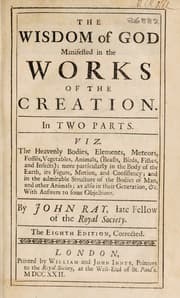
John Ray's monograph represents a pivotal contribution to natural theology and the physico-theological argument for God's existence. Writing in the aftermath of the Scientific Revolution, Ray systematically examines the natural world to demonstrate divine design and wisdom. His work stands as one of the most comprehensive early modern attempts to reconcile scientific observation with theological conviction.
Ray employs an empirical method grounded in detailed natural history. As a pioneering botanist and zoologist, he draws upon extensive fieldwork and taxonomic studies to catalog the intricate structures and behaviors of plants and animals. Each observation serves as evidence for purposeful design: the eye's complex anatomy, the bee's hexagonal honeycomb, the bird's hollow bones enabling flight. Ray argues that such features cannot arise from chance or mechanical necessity alone but require an intelligent designer.
The work directly counters materialist and atomist philosophies gaining currency in late seventeenth-century thought. Against Epicurean notions of random atomic combinations and Cartesian mechanism, Ray insists that nature's complexity and adaptation demonstrate intentional creation. He particularly challenges those who would explain organic forms through purely physical causes, arguing that the fitness of organisms to their environments reveals providential planning.
Ray's significance extends beyond mere cataloging of design examples. He develops a sophisticated understanding of ecological relationships and functional anatomy that anticipates later biological insights. His argument moves beyond simple wonder at creation to systematic analysis of how structures serve purposes within integrated natural systems. This methodological rigor distinguishes his natural theology from more superficial design arguments.
The monograph's influence on subsequent God debates proves substantial. Ray establishes a template for physico-theological reasoning that shapes eighteenth-century natural theology, notably influencing William Paley. His work demonstrates how serious engagement with empirical science could support rather than undermine religious belief, providing a model for those seeking to ground faith in natural knowledge.
Ray's contribution lies not merely in accumulating design examples but in showing how systematic natural history could serve theological ends. His careful observations and classifications create a formidable challenge to those who would explain nature without reference to divine intelligence, establishing parameters for design arguments that persist in modified forms within contemporary intelligent design discourse.
Argument formulations engaged
Ray, John (1691). The Wisdom of God Manifested in the Works of Creation.
@book{the-wisdom-of-god-manifested-in-the-work,
  author    = {Ray, John},
  title     = {The Wisdom of God Manifested in the Works of Creation},
  year      = {1691},
  url       = {https://god-database.com/en/works/the-wisdom-of-god-manifested-in-the-works-of-creation-1691}
}