
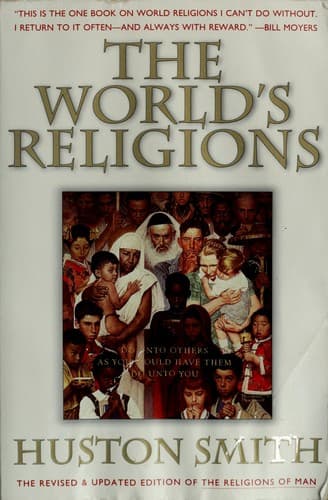
The World's Religions
أديان العالم
Les Religions du Monde
Editorial summary
This comprehensive study examines the world's major religious traditions through a phenomenological lens, presenting each faith system from within its own framework of meaning. Smith analyzes Hinduism, Buddhism, Confucianism, Taoism, Islam, Judaism, Christianity, and primal religions, focusing on their core teachings, spiritual practices, and distinctive worldviews rather than their historical development or institutional structures.
The work employs a sympathetic insider perspective, attempting to convey what each tradition feels like to its adherents rather than imposing external critical judgments. Smith's methodology draws from the phenomenological tradition in religious studies, particularly the approaches of scholars like Mircea Eliade and Joachim Wach, who emphasized understanding religious phenomena through believers' own categories and experiences. This approach stands in deliberate contrast to reductionist analyses that would explain religion primarily through psychological, sociological, or evolutionary frameworks.
Central to Smith's argument is the claim that despite surface differences, the world's religions share profound commonalities in their recognition of transcendent reality and their function as paths to spiritual transformation. He presents each tradition as a valid response to ultimate questions about meaning, purpose, and the nature of the divine or absolute. The text implicitly critiques both religious exclusivism and secular dismissals of religious wisdom, suggesting instead that humanity's diverse spiritual traditions represent complementary approaches to perennial human concerns.
The work's significance for the God debate lies in its implicit theological pluralism and its challenge to both traditional apologetics and modern secularism. By presenting multiple conceptions of ultimate reality as equally profound and transformative, Smith undermines arguments for the unique truth of any single tradition while simultaneously defending the general validity of religious approaches to ultimate questions. His emphasis on the experiential and transformative dimensions of religion offers a response to purely intellectual critiques of theism.
Smith's analysis reflects the comparative religion movement of the mid-twentieth century, with its emphasis on finding universal patterns across traditions. While later scholarship has criticized such approaches for potentially obscuring real differences between religions, the work remains influential in demonstrating how diverse conceptions of the sacred can be presented as intellectually and spiritually serious options in contemporary discourse about ultimate reality and human meaning.
Argument formulations engaged
Related works
Smith, Huston (1991). The World's Religions. HarperOne.
@book{the-worlds-religions-1991,
  author    = {Smith, Huston},
  title     = {The World's Religions},
  year      = {1991},
  publisher = {HarperOne},
  url       = {https://god-database.com/en/works/the-worlds-religions-1991}
}