
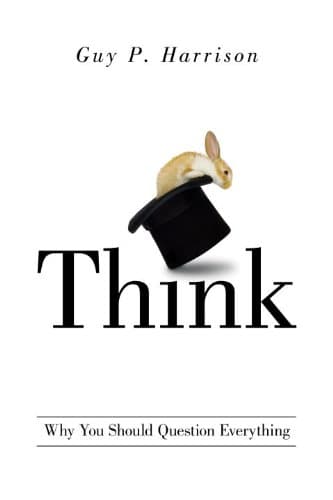
Think: Why You Should Question Everything
فكر: لماذا يجب أن تشكك في كل شيء
Pensez : Pourquoi Vous Devriez Tout Remettre en Question
Editorial summary
In Think: Why You Should Question Everything, Guy P. Harrison presents a practical guide to critical thinking that positions skeptical inquiry as essential for navigating contemporary life, with particular attention to religious and supernatural claims. While not exclusively focused on the God debate, Harrison's work contributes to this discourse by advocating for the systematic application of skeptical principles to all belief systems, especially those involving divine or paranormal assertions.
Harrison structures his argument around the premise that human cognitive biases and social pressures frequently lead to the acceptance of unfounded beliefs. He draws extensively from psychology, neuroscience, and evolutionary biology to explain why humans are naturally predisposed to pattern recognition, agency detection, and confirmation bias—tendencies that he argues contribute to religious belief formation. The work examines how these cognitive mechanisms, while evolutionarily advantageous, can lead to false conclusions about supernatural phenomena and divine intervention.
The book's approach differs from traditional philosophical atheism by emphasizing practical skepticism over metaphysical arguments. Rather than engaging directly with theological proofs or ontological debates, Harrison focuses on methodology: how individuals should evaluate claims, assess evidence, and recognize their own cognitive limitations. He presents critical thinking not as an academic exercise but as a necessary life skill, using accessible examples from pseudoscience, conspiracy theories, and religious claims to illustrate broader principles.
Harrison's contribution to the God debate lies primarily in his democratization of skeptical tools. He argues that questioning religious authority and supernatural claims should not be the exclusive domain of philosophers or scientists but a basic competency for all citizens in pluralistic societies. The work implicitly challenges what Harrison sees as the privileged position of religious beliefs, arguing they should be subjected to the same scrutiny as any other knowledge claim.
The text engages with the social dimensions of belief, examining how community pressure, emotional investment, and cultural tradition insulate religious ideas from critical examination. Harrison addresses the common objection that skepticism leads to cynicism or meaninglessness, arguing instead that honest inquiry enhances rather than diminishes human experience. His work represents a populist strand within the broader skeptical movement, attempting to make rigorous thinking about ultimate questions accessible to general audiences while maintaining that extraordinary claims, including those about God, require extraordinary evidence.
Argument formulations engaged
Harrison, Guy P. (2013). Think: Why You Should Question Everything. Prometheus Books.
@book{think-why-you-should-question-everything,
  author    = {Harrison, Guy P.},
  title     = {Think: Why You Should Question Everything},
  year      = {2013},
  publisher = {Prometheus Books},
  url       = {https://god-database.com/en/works/think-why-you-should-question-everything-2013}
}