
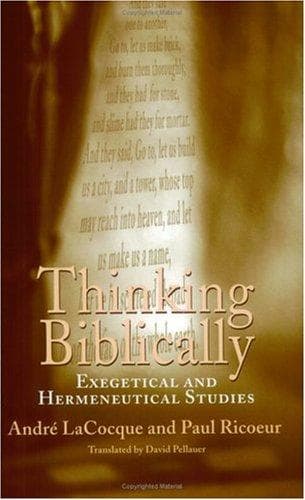
Thinking Biblically
التفكير بطريقة كتابية
Penser Bibliquement
Editorial summary
This work represents Ricoeur's mature engagement with biblical texts through the lens of philosophical hermeneutics, examining how scriptural narratives shape human self-understanding and ethical consciousness. Rather than approaching the Bible as a repository of doctrinal propositions about God's existence, Ricoeur treats it as a complex literary corpus that configures human experience through narrative, law, prophecy, wisdom, and praise. His analysis demonstrates how biblical thinking operates through a distinctive logic of superabundance and excess that challenges both onto-theological metaphysics and reductive secularism.
Ricoeur's method combines structural analysis with phenomenological interpretation, revealing how biblical texts create what he terms a "world of the text" that readers can inhabit imaginatively. He argues that biblical narratives do not primarily function as historical reports or metaphysical arguments but as poetic discourses that refigure temporal existence and open new possibilities for self-understanding. The concept of testimony emerges as crucial, not as empirical evidence for divine action, but as a hermeneutical category that links historical contingency with absolute meaning. This approach sidesteps traditional natural theology while maintaining the irreducibility of religious discourse to purely anthropological categories.
The work engages critically with both Bultmannian demythologization and structuralist approaches that would reduce biblical meaning to ahistorical codes. Against Bultmann, Ricoeur maintains that myth and symbol possess cognitive value that cannot be fully translated into existential categories. Against structuralism, he insists on the referential dimension of texts and their capacity to redescribe reality. His analysis of biblical time, particularly the interplay between promise and fulfillment, demonstrates how these texts configure a distinctive temporal consciousness that resists both cyclical and purely linear models.
Ricoeur's contribution to debates about God lies in his sophisticated account of how religious language functions productively without requiring metaphysical foundations. By focusing on the transformative power of biblical discourse rather than its propositional content, he opens space for post-critical faith that neither retreats into fundamentalism nor dissolves into secular humanism. The work suggests that the question of God cannot be separated from the question of how texts shape human existence, making hermeneutics itself a theological endeavor. This positions religious thought as an irreducible dimension of human experience rather than a primitive stage to be overcome, while avoiding both dogmatic assertion and reductive critique.
Argument formulations engaged
Ricoeur, Paul (1998). Thinking Biblically.
@book{thinking-biblically-1998,
  author    = {Ricoeur, Paul},
  title     = {Thinking Biblically},
  year      = {1998},
  url       = {https://god-database.com/en/works/thinking-biblically-1998}
}