
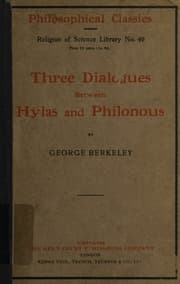
Three Dialogues between Hylas and Philonous
ثلاثة حوارات بين هيلاس وفيلونوس
Trois Dialogues entre Hylas et Philonous
Berkeley argues, through the dialogue between Hylas and Philonous, that the existence of material substance is incoherent and that sensible things exist only as ideas in minds, a conclusion that entails the existence of an infinite divine Mind sustaining the order of human experience.
Editorial summary
George Berkeley's Three Dialogues between Hylas and Philonous presents a sustained philosophical defense of immaterialism through dramatic dialogue, ultimately grounding reality in the mind of God. Written in 1713, the work stages conversations between Philonous (representing Berkeley's position) and Hylas (defending material substance), systematically dismantling the notion that matter exists independently of perception. Berkeley employs this dialogical format to demonstrate how his idealist metaphysics not only avoids the skepticism plaguing materialism but necessarily leads to theistic conclusions.
The work's central argument proceeds by establishing that all perceived qualities exist only in minds, leaving the supposed material substratum conceptually empty. Berkeley then argues that the coherence and continuity of phenomenal experience requires a divine perceiver. When finite minds are not perceiving particular objects, those objects persist in the infinite mind of God. This move transforms what might seem a skeptical conclusion into a theistic proof: the orderly succession of ideas constituting nature becomes direct evidence of God's existence and continuous creative activity.
Berkeley's engagement with cosmological reasoning takes a distinctive form. Rather than arguing from the existence of material things to a first cause, he contends that the very notion of causation properly understood points to spiritual agency. Only minds can be genuine causes, and the regular patterns observed in nature reveal not mechanical laws but the consistent will of an omnipotent spirit. This reconceptualization addresses Cartesian and Lockean difficulties about how matter and mind interact by denying material substance altogether.
The work also develops an argument from religious experience, though not in conventional terms. Berkeley suggests that in perceiving nature, minds directly encounter God's ideas. Sensory experience itself becomes a form of divine communication, with the natural world serving as God's language to finite spirits. This immediacy of divine presence in everyday perception offers a response to deistic tendencies that would distance God from creation.
Berkeley's rationalist methodology deploys careful conceptual analysis to reach metaphysical conclusions with theological import. By reducing material substance to contradictions and establishing mind as the only coherent category of existence, he constructs a philosophical system where God's existence becomes not merely probable but necessary for the intelligibility of experience itself. The dialogue format allows Berkeley to anticipate and address objections while demonstrating how immaterialism, far from leading to skepticism, provides the firmest foundation for both natural knowledge and religious belief.
Structured analysis
Argument formulations engaged
Related works
Berkeley, George Three Dialogues between Hylas and Philonous.
@book{three-dialogues-between-hylas-and-philon,
  author    = {Berkeley, George},
  title     = {Three Dialogues between Hylas and Philonous},
  year      = {n.d.},
  url       = {https://god-database.com/en/works/three-dialogues-between-hylas-and-philonous}
}