
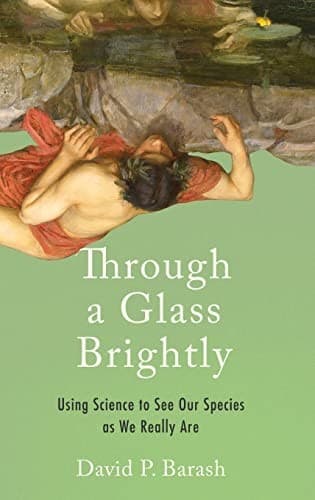
Through a Glass Brightly: Using Science to See Our Species as We Really Are
عبر زجاج مضيء: استخدام العلم لرؤية جنسنا كما نحن حقاً
À Travers un Verre Brillant : Utiliser la Science pour Voir Notre Espèce Telle qu'Elle Est Vraiment
Editorial summary
Through a Glass Brightly offers a naturalistic examination of human nature through the lens of evolutionary biology, arguing that scientific understanding provides the clearest vision of what humans truly are—without recourse to supernatural explanations. David P. Barash, an evolutionary biologist and psychologist, constructs his argument against various forms of human exceptionalism, particularly those rooted in religious worldviews that posit humans as specially created or fundamentally distinct from other animals.
The work systematically dismantles what Barash terms "illusions" about human uniqueness, addressing claims about consciousness, morality, culture, and meaning that traditionally serve as bulwarks for theistic perspectives on human nature. His methodology combines evolutionary theory with comparative biology, demonstrating how traits once considered uniquely human—such as tool use, self-awareness, and even rudimentary moral behavior—exist along continuums shared with other species. This approach directly challenges theological anthropologies that ground human dignity and purpose in divine creation or the imago Dei.
Barash engages particularly with what he sees as the persistent tendency to invoke God or transcendent purpose when confronting uncomfortable truths about human nature. He argues that accepting our biological reality—including our capacity for violence, tribalism, and self-deception—requires abandoning comforting supernatural narratives. The text positions itself against both explicit religious accounts and what Barash identifies as crypto-religious thinking in secular contexts, where notions of human specialness persist without theological justification.
The book's contribution to the God debate lies in its comprehensive application of evolutionary thinking to questions traditionally answered by theology. Barash contends that science not only explains human origins without divine intervention but also provides sufficient resources for meaning-making and moral development. He addresses the common objection that naturalistic accounts of humanity lead to nihilism, arguing instead that clear-sighted acceptance of our evolved nature enables more authentic human flourishing.
The work stands as a significant entry in contemporary naturalistic philosophy, extending the tradition of thinkers like Daniel Dennett and Richard Dawkins while focusing specifically on anthropological questions. Its importance lies not merely in rehearsing arguments against divine creation but in demonstrating how evolutionary biology offers a complete alternative framework for understanding human nature, purpose, and potential—one that Barash argues renders theological explanations obsolete.
Argument formulations engaged
Barash, David P. (2018). Through a Glass Brightly: Using Science to See Our Species as We Really Are. Oxford University Press, USA.
@book{through-a-glass-brightly-using-science-t,
  author    = {Barash, David P.},
  title     = {Through a Glass Brightly: Using Science to See Our Species as We Really Are},
  year      = {2018},
  publisher = {Oxford University Press, USA},
  url       = {https://god-database.com/en/works/through-a-glass-brightly-using-science-to-see-our-species-as-we-really-are-2018}
}