
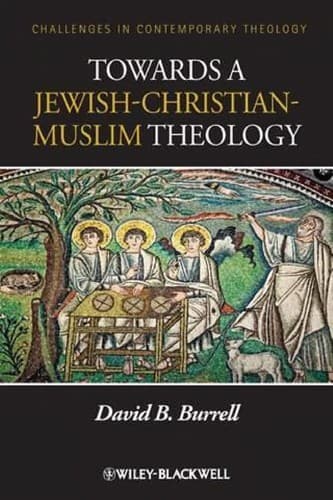
Towards a Jewish-Christian-Muslim Theology.. Challenges in Contemporary Theology
نحو لاهوت يهودي-مسيحي-إسلامي.. تحديات اللاهوت المعاصر
Vers une théologie judéo-chrétienne-musulmane.. Défis de la théologie contemporaine
A genuinely shared theology of God is possible across Judaism, Christianity, and Islam when each tradition is engaged on its own terms and in honest dialogue with the others.
Editorial summary
David B. Burrell's "Towards a Jewish-Christian-Muslim Theology" represents a significant contribution to contemporary interfaith theological discourse, proposing that the three Abrahamic traditions share sufficient philosophical and theological ground to develop a genuinely trilateral theology. Writing from within the framework of comparative theology, Burrell argues that Judaism, Christianity, and Islam possess overlapping conceptual resources that, when properly understood, enable constructive theological dialogue rather than mere tolerance or coexistence.
The work's central thesis challenges the prevalent assumption that these traditions represent fundamentally incompatible theological systems. Burrell demonstrates how medieval philosophical exchanges among Jewish, Christian, and Muslim thinkers—particularly through figures like Maimonides, Aquinas, and Ibn Sina—created a shared intellectual vocabulary that contemporary theologians can recover and extend. His methodology involves careful textual analysis of classical sources while maintaining sensitivity to each tradition's distinctive claims and practices.
Burrell engages substantively with prophecy as a theological category that all three traditions share yet interpret differently. He examines how each tradition understands divine revelation, the nature of prophetic authority, and the relationship between reason and revealed truth. Rather than minimizing these differences, Burrell argues that acknowledging them creates space for meaningful theological conversation. His analysis reveals how the prophecy argument functions differently within each tradition while maintaining family resemblances that enable mutual comprehension.
The monograph's significance extends beyond academic theology to address practical challenges facing religious communities in pluralistic societies. Burrell critiques both exclusivist theologies that deny validity to other traditions and relativist approaches that abandon truth claims altogether. Instead, he proposes a "theology of religious diversity" that maintains each tradition's integrity while fostering genuine intellectual exchange.
Burrell's comparative theological method draws on his extensive work translating medieval Islamic philosophy and his engagement with contemporary Jewish thought. This background enables him to identify conceptual bridges between traditions without collapsing their distinctions. His approach particularly challenges Christian theologians to reconsider supersessionist assumptions while encouraging all three traditions to recognize their shared Abrahamic heritage as a theological resource rather than merely a historical curiosity.
The work ultimately argues that developing a Jewish-Christian-Muslim theology requires moving beyond dialogue about theology to actual collaborative theological reflection, where practitioners from each tradition contribute to understanding divine reality through their particular perspectives.
Structured analysis
Structure of the work
Argument formulations engaged
Related works
Burrell, David B. (2011). Towards a Jewish-Christian-Muslim Theology.. Challenges in Contemporary Theology. Wiley-Blackwell.
@book{towards-a-jewish-christian-muslim-theolo,
  author    = {Burrell, David B.},
  title     = {Towards a Jewish-Christian-Muslim Theology.. Challenges in Contemporary Theology},
  year      = {2011},
  publisher = {Wiley-Blackwell},
  url       = {https://god-database.com/en/works/towards-a-jewish-christian-muslim-theology-challenges-in-contemporary-theology}
}